Research
(Advertisement)


What is the Clarity Act?
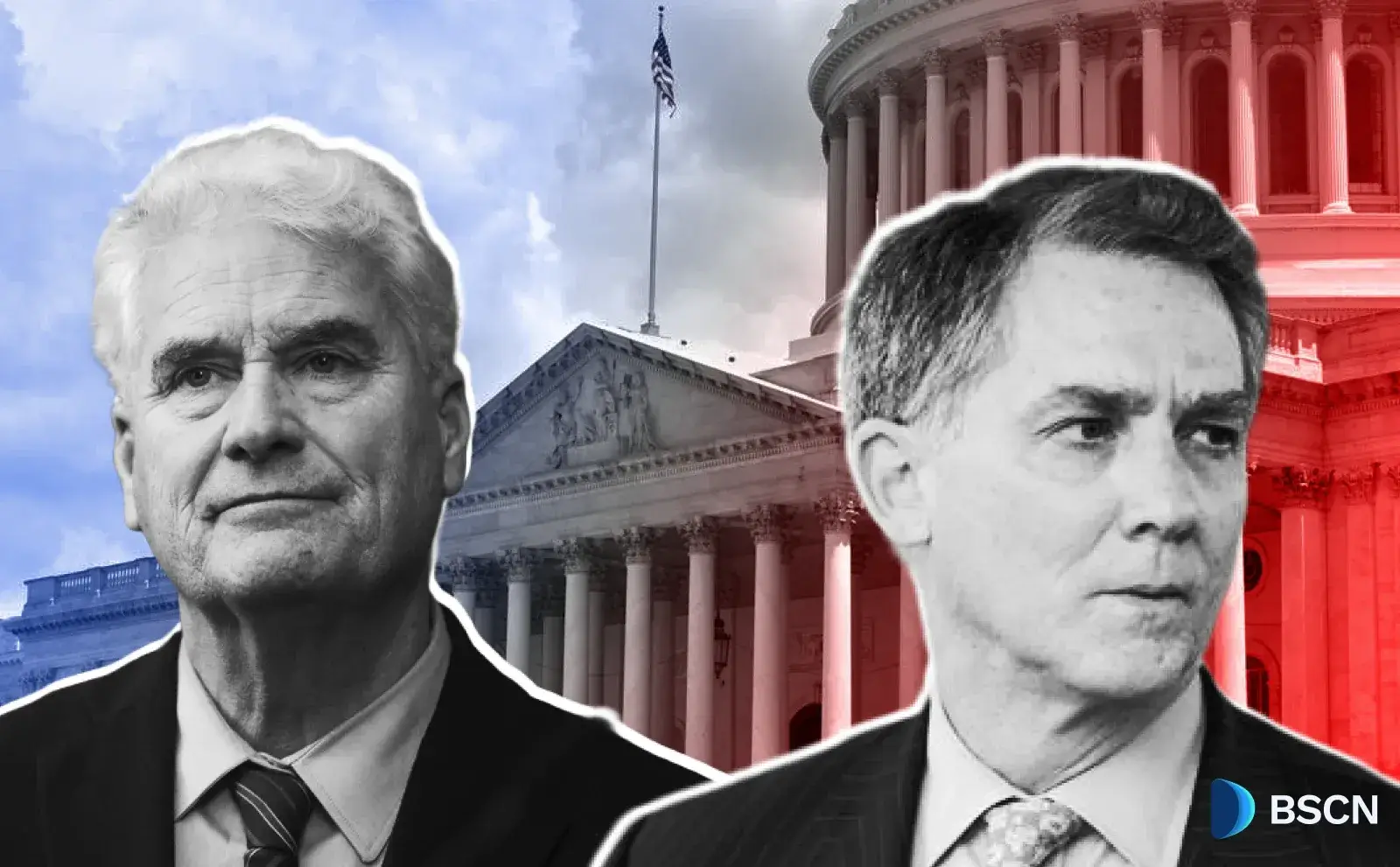
The CLARITY Act defines U.S. digital asset regulation, clarifies SEC and CFTC jurisdiction, and establishes federal oversight standards.

UC Hope
February 24, 2026

(Advertisement)
Table of Contents
For more than a decade, digital assets have existed in a legal gray area in the United States. Many investors, developers, and financial institutions still do not clearly understand how crypto assets are regulated or which federal agency is in charge.
Two regulators, the U.S. Securities and Exchange Commission (SEC) and the Commodity Futures Trading Commission (CFTC), have both asserted authority over parts of the crypto market. Their overlapping interpretations, often grounded in enforcement actions rather than new rulemaking, created what market participants describe as “regulation by enforcement.”
The Digital Asset Market Clarity Act of 2025, commonly known as the CLARITY Act, seeks to resolve this uncertainty. It aims to define which digital assets are securities, which are commodities, and how each should be regulated.
This week, the Senate is preparing for a key procedural markup on the legislation. Supporters describe the bill as a comprehensive framework for market structure. Critics question whether it sufficiently protects investors and whether the CFTC has the resources to oversee expanded markets.
Understanding the CLARITY Act requires context: how U.S. crypto regulation developed, what the bill changes, and what risks remain.
What Problem Is the CLARITY Act Trying to Fix?
Fragmented Oversight
Since the emergence of Bitcoin and other blockchain-based assets, federal regulators have relied on decades-old statutes. The SEC has argued that most token offerings qualify as securities under the 1946 Supreme Court precedent known as the Howey test. The CFTC has treated certain decentralized tokens as commodities, particularly in derivatives markets.
The SEC, under former Chair Gary Gensler, brought dozens of enforcement actions against token issuers, exchanges, and intermediaries. However, it declined to create rules specific to digital assets. The CFTC, meanwhile, warned of gaps in spot market oversight, as its authority under the Commodity Exchange Act primarily covers anti-fraud and anti-manipulation enforcement in spot markets.
The result: inconsistent classifications, uncertainty over compliance obligations, and reluctance from traditional financial institutions to participate.
Legislative Response
Congress responded with several proposals. In July 2025, lawmakers passed the Guiding and Establishing National Innovation for U.S. Stablecoins Act of 2025, commonly called the Guiding and Establishing National Innovation for U.S. Stablecoins Act of 2025 (GENIUS Act), which addressed stablecoin issuance.
The CLARITY Act extends beyond stablecoins to define the structure of the broader digital asset market.
How Does the CLARITY Act Classify Digital Assets?
At the core of the CLARITY Act is a three-part classification framework:
1. Digital Commodities
A digital commodity is a digital asset intrinsically linked to a blockchain system, whose value derives from the network’s functionality. This includes assets used for payments, governance, validation, or service access.
The definition excludes securities, derivatives, and stablecoins.
Under the Act:
- The CFTC receives exclusive jurisdiction over anti-fraud and anti-manipulation enforcement in digital commodities, including spot markets.
- Exchanges and broker-dealers handling digital commodities must register with the CFTC.
- Platforms must meet listing standards, capital adequacy requirements, trade surveillance standards, and segregation of customer funds.
Digital commodity exchanges must also ensure issuers comply with disclosure obligations, including publication of source code, transaction history, and digital asset economics.
2. Investment Contract Assets
An investment contract asset is a digital commodity sold pursuant to an investment contract for capital raising. In this phase, the token is treated as a security and falls under SEC jurisdiction.
Key points include:
- SEC oversight applies during issuance.
- Issuers must provide disclosures and comply with resale restrictions.
- The status is temporary.
Once an asset is sold in secondary markets by someone other than the issuer or its agent, it becomes a digital commodity. At that stage, oversight shifts to the CFTC.
The Act also establishes a “maturity” certification process. A blockchain system qualifies as mature if:
- It is functional for transactions or governance.
- Its code is open-source.
- It operates under transparent rules.
- No single entity controls 20% or more of tokens.
This maturity concept functions similarly to lock-up restrictions in traditional securities offerings.
3. Permitted Payment Stablecoins
Permitted payment stablecoins must:
- Be designed for payment or settlement.
- Be denominated in a national currency.
- Be issued by regulated entities.
- Include a repurchase obligation at a fixed monetary value.
Issuers are supervised by banking regulators. However, both the SEC and CFTC retain anti-fraud authority over transactions on regulated platforms.
How Does the Bill Address Intermediaries?
The CLARITY Act imposes registration and operational requirements on exchanges, broker-dealers, and other intermediaries.
CFTC-Regulated Entities Must:
- Segregate customer funds.
- Use qualified digital asset custodians.
- Maintain capital and risk management systems.
- Join a registered futures association.
- Restrict conflicts of interest.
Customer participation in staking or blockchain services must be voluntary.
SEC Adjustments
The SEC must modernize recordkeeping rules to allow blockchain-based books and records. The Act prevents the SEC from excluding trading platforms from exemptions solely because they list digital assets.
Digital commodities are classified as “covered securities,” thereby preempting certain state-level blue-sky laws.
Does the CLARITY Act Protect Software Developers and Self-Custody?
Yes. The bill explicitly states that developers who publish or maintain code without controlling customer funds are not treated as financial intermediaries.
Certain decentralized finance (DeFi) activities are exempt from registration requirements if participants:
- Validate transactions.
- Provide computational work.
- Develop trading protocols or wallets.
- Provide user interfaces.
However, anti-fraud and anti-manipulation enforcement still applies.
The Act also preserves the right to self-custody digital assets.
What About Anti-Money Laundering and National Security?
The legislation includes expanded anti-money laundering (AML) and counter-terrorist financing requirements for digital asset intermediaries:
- Applies Bank Secrecy Act requirements.
- Strengthens sanctions compliance.
- Authorizes the Treasury Department to address high-risk foreign activity.
Supporters describe it as the strongest illicit finance framework considered for digital assets to date.
What Is the New Capital Raising Exemption?
The Act introduces a Securities Act exemption for token offerings if:
- Aggregate sales do not exceed $75 million in 12 months.
- No purchaser acquires more than 10% of the total supply in a single offering.
- The issuer is U.S.-organized.
Issuers must provide extensive pre-offering disclosures and semi-annual updates until blockchain maturity certification.
This structure attempts to balance capital formation with investor protection.
What Are the Main Criticisms?
Critics raise several concerns:
Regulatory Arbitrage
Because tokens transition from securities to commodities after issuance, issuers may attempt to structure offerings to minimize SEC oversight.
CFTC Capacity
The CFTC historically regulates derivatives markets. It has limited experience supervising retail-facing spot markets at scale. Expanding its mandate would require increased funding and staffing.
Investor Protection
Some policy experts argue that reducing SEC oversight post-issuance could weaken investor protections. Others argue key terms remain undefined, potentially leading to continued litigation.
How Does the Senate Version Differ?
The House passed the CLARITY Act in July 2025 during “Crypto Week” with bipartisan support.
The Senate Banking Committee later introduced the Responsible Financial Innovation Act (RFIA), which emphasizes SEC authority and introduces the concept of “ancillary assets.” The Senate version instructs the SEC to develop Regulation DA and clarify the definition of “investment contract.”
The path forward likely involves reconciliation between House and Senate frameworks.
Senate Banking Chairman Tim Scott has stated that lawmakers aim to complete market structure legislation by September 30, 2025.
What Does the CLARITY Act Mean for the Crypto Industry?
If enacted, the Act would:
- Replace fragmented oversight with statutory classifications.
- Shift much spot market supervision to the CFTC.
- Provide defined pathways for token issuance.
- Clarify custody treatment and balance sheet accounting.
- Encourage institutional participation through regulatory clarity.
Traditional financial institutions may benefit from clarified custody rules and reduced accounting ambiguity. Developers gain defined compliance standards. Exchanges face stricter capital and surveillance requirements.
The bill’s impact ultimately depends on final Senate revisions and implementation funding.
Conclusion
The CLARITY Act represents Congress’s most detailed attempt to define federal crypto regulation. It establishes asset classifications, reallocates jurisdiction between the SEC and CFTC, imposes registration requirements on intermediaries, strengthens anti-money laundering standards, and clarifies custody rules.
Supporters argue that clear statutory definitions reduce reliance on enforcement-driven regulation. Critics question whether investor protections and agency resources are sufficient. The Senate’s deliberations will determine whether the final legislation aligns more closely with the House framework or adopts a revised model.
What remains consistent is the bill’s objective: replace regulatory ambiguity with a defined federal framework governing digital asset markets in the United States.
Sources
- Congressional bill text: Digital Asset Market Clarity Act of 2025 (H.R. 3633)
- Senate Banking Committee discussion draft: Responsible Financial Innovation Act of 2025
- Arnold&Porter: Clarifying the CLARITY Act
- United States Senate Committee on Banking, Housing, and Urban Affairs: Myths and Facts about the Clarity Act





Frequently Asked Questions
What is the main goal of the CLARITY Act?
The CLARITY Act aims to define whether digital assets are securities, commodities, or stablecoins, and to assign regulatory authority between the SEC and the CFTC accordingly.
Does the CLARITY Act ban self-custody?
No. The bill explicitly preserves individuals' right to hold digital assets in self-custody wallets.
Who regulates digital commodities under the CLARITY Act?
The CFTC would have exclusive anti-fraud and anti-manipulation jurisdiction over digital commodities, including spot markets, while the SEC would retain authority over capital-raising phases involving investment contract assets.
Disclaimer
Disclaimer: The views expressed in this article do not necessarily represent the views of BSCN. The information provided in this article is for educational and entertainment purposes only and should not be construed as investment advice, or advice of any kind. BSCN assumes no responsibility for any investment decisions made based on the information provided in this article. If you believe that the article should be amended, please reach out to the BSCN team by emailing [email protected].
Author
 UC Hope
UC holds a bachelor’s degree in Physics and has been a crypto researcher since 2020. UC was a professional writer before entering the cryptocurrency industry, but was drawn to blockchain technology by its high potential. UC has written for the likes of Cryptopolitan, as well as BSCN. He has a wide area of expertise, covering centralized and decentralized finance, as well as altcoins.
(Advertisement)
Latest News
1h : 38m ago

Buterin's 10,000 $ETH Selling Spree: Why Now?
3h : 12m ago

A Closer Look at Backpack's $BP Token
4h : 43m ago

Ethereum Unveils Massive Staking Plans: 70,000 $ETH to Hit The Network
6h : 3m ago

Three Major Solana Platforms Announce Full Shutdown: Report
7h : 8m ago

Analysing Paradex: Zero-Fee Perps with Privacy
8h : 22m ago
What is the Clarity Act?
10h : 44m ago

Pi Network Celebrates One Year Post-Open Network: What Has Changed Since Launch?
11h : 59m ago

Is Jane Street Behind the 2022 Crypto Collapse?
(Advertisement)

Crypto Project & Token Reviews
Project & Token Reviews
Comprehensive reviews of crypto's most interesting projects and assets
Learn about the hottest projects & tokens