Deepdive
(Advertisement)


Analysing Paradex: Zero-Fee Perps with Privacy
Paradex offers zero-fee perpetual futures trading with built-in ZK privacy on a custom L2. Here is what traders need to know about this rising perps contender.

Crypto Rich
February 24, 2026

(Advertisement)
Table of Contents
Paradex is a decentralized perpetual futures exchange that charges retail traders zero maker and taker fees while keeping their positions private through zero-knowledge encryption. Running on its own high-performance Layer 2 blockchain called Paradex Chain, the platform is incubated by Paradigm, an institutional derivatives network that has processed over $1 trillion in trading volume. In a perps landscape dominated by Hyperliquid, dYdX, and GMX, Paradex is carving out its place with a different playbook: trade for free, trade in private.
The decentralized perps market crossed $1 trillion in monthly volume for the first time in September 2025, and that number kept climbing through Q4. In that kind of environment, a new contender needs more than just a slick UI to stand out. Paradex is betting that fee-free trading and encrypted trading data are enough to pull serious traders away from the competition. So far, the numbers suggest the bet is paying off.
How Much Traction Has Paradex Gained?
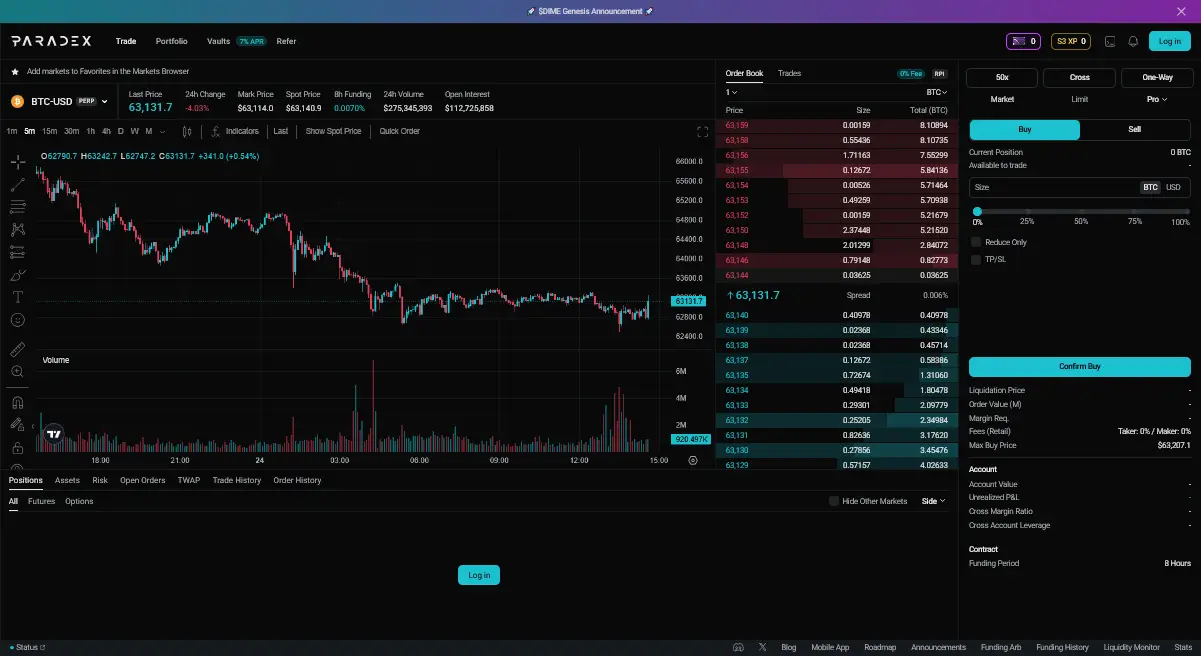
The growth during Season 2 of its XP rewards program tells the story best. Average daily volume grew from $68 million to $2.1 billion (a 31x increase), open interest jumped from $28 million to $679 million (24x), TVL climbed from $25 million to $218 million (9x), and total users grew from 4,100 to over 70,300 (17x).
At the time of writing, live platform data shows:
- 24-hour trading volume around $335 million
- Open interest at $547.5 million
- TVL of $156.7 million
- Over 76,000 users
- 93 futures markets listed, with 250+ markets total across perps, spot, and options
Those are not Hyperliquid numbers, but for a platform that only launched its appchain and zero-fee perps in 2025, it represents serious early traction in one of DeFi's most competitive sectors.
How Do Zero Fees Actually Work?
Paradex's zero-fee model is not a promotional offer. It is built into the platform's revenue structure through a system called Retail Price Improvement (RPI).
Professional market makers post quotes visible only in the Paradex UI, hidden from APIs. These quotes match exclusively against retail traders. In exchange for access to this clean, non-toxic flow, makers pay Paradex a micro-fee. High-frequency traders using the API pay standard trading fees. Retail users trading through the interface pay nothing on over 100 perpetual markets, win or lose, with only spreads and funding rates as costs.
The model draws comparisons to payment for order flow in traditional finance, but with an important distinction: multiple market makers compete openly for retail flow rather than one firm getting exclusive access. That competition keeps spreads tighter for retail traders while giving Paradex a sustainable revenue stream without taxing its core user base.
Paradex extended this no-cost approach to spot trading earlier this month, with ETH spot launching on February 17.
What Makes the Privacy Layer Different?
Privacy Perps went live on mainnet in December 2025, and this is where Paradex really separates itself.
Using end-to-end ZK encryption across Paradex Cloud, the L2 chain, and Ethereum settlement, only account holders can view their positions, entries, exits, liquidation levels, and PnL. On L2, access to private trading data is gated through authenticated RPC calls, meaning external observers cannot reconstruct account states. On L1, state updates posted to Ethereum are encrypted and verified using ZK proofs, closing off the data availability path entirely.
For anyone who has traded on-chain, the value here is obvious. Public ledgers let anyone track whale wallets, front-run large orders, and target accounts approaching liquidation. MEV bots thrive in this environment. Paradex removes that attack surface by keeping trades off public mempools entirely.
The practical effect is CEX-level privacy in a self-custodial setup. Whales can build positions without broadcasting their strategy. Hedgers can operate without leaking alpha. For institutional capital that has stayed away from DeFi partly due to on-chain transparency, this removes one of the biggest reasons they have sat on the sidelines.
What is the $DIME Token and XP System?
Paradex rewards users through an Experience Points system that tracks trading volume, holding periods, and vault deposits. XP converts to $DIME tokens at the upcoming token generation event.
According to official announcements, 25% of the fully diluted $DIME supply will be airdropped to XP holders at TGE, fully unlocked. Of that, 20% goes to Season 2 holders and 5% to Pre-Season and Season 1 participants.
Season 2 ended in late January 2026, with its final week distributing 6 million XP across 20,244 wallets. XP Season 3 kicked off on February 1 and focuses on spot, RWA perps, and options activity. The first Season 3 distribution on February 18 sent 9.7 million XP to 14,500 wallets for activity during February 1 through 17.
The $DIME TGE is planned for after the Chinese New Year holiday, targeting late February or early March 2026. $DIME will initially list on Paradex's own spot markets.
On the affiliate side, Paradex takes a different approach from the typical KOL kickback model. Through its Token Aligned Program (TAP), tokens are allocated directly to affiliates for long-term ownership rather than paying commissions funded by user fees. The idea is alignment over extraction.
Has Paradex Hit Any Bumps?
No platform scaling this fast avoids rough patches entirely. On January 19, 2026, a planned database upgrade triggered a race condition that corrupted on-chain market data, resetting funding indices and causing mass liquidations across multiple markets. It was a serious incident. Paradex responded by rolling the chain back to its last healthy state, restoring full operations within hours, and refunding $650,000 to roughly 200 affected accounts from the Liquidator Vault. The team published a post-mortem and implemented enhanced restart procedures, additional data validation, and price-band protections for post-maintenance periods.
These are the kinds of operational challenges that come with running a custom appchain at scale. Paradex owned it publicly and moved fast to make users whole.
Where Does Paradex Fit in the Perps Landscape?
The perps sector has evolved into one of DeFi's most competitive verticals. Hyperliquid still leads on volume and mindshare. Aster and Lighter have surged as serious contenders. Paradex is not trying to out-volume these platforms head-on. Its angle is distinct: zero-fee, private trading on a purpose-built chain.
The roadmap supports this positioning. Perpetual options expand the product lineup, offering volatility plays and dynamic hedging with no liquidation risk for buyers. Tokenized vaults and unified cross-margin broaden the product surface toward what the team calls a financial supercenter. Cross-chain access through Orbiter integration keeps the onboarding friction low.
With the $DIME TGE approaching, Season 3 underway, and expanding product lines in spot and options, Paradex is entering 2026 with strong momentum. Whether it captures lasting market share comes down to execution, but the early numbers back it up.
For traders looking to explore Paradex, visit paradex.trade or follow @Paradex on X for the latest updates.
Sources:
- Paradex - Official platform with live trading data, RPI documentation, and privacy architecture details
- Paradex Documentation - Technical docs covering fee structures, perpetual options, and market specifications
- CryptoBriefing - Coverage of Privacy Perps mainnet launch in December 2025
- Cointelegraph - Post-mortem coverage of the $650K refund and platform safeguards
- The Block - Industry data on perp DEX volume milestones in 2025
- DefiLlama - Independent TVL, volume, and open interest tracking for Paradex
- FalconX Research - Market share analysis and institutional comparison metrics
- Paradex on X - Official announcements including XP distributions, TGE timeline, and Season 3 details



Frequently Asked Questions
What fees does Paradex charge retail traders?
Paradex charges zero maker and taker fees on perpetual futures and spot markets for retail users trading through the UI. The only costs are spreads and funding rates. The platform earns revenue from micro-fees paid by professional market makers and from liquidation fees.
How does Paradex keep trading positions private?
Paradex uses zero-knowledge encryption across its L2 chain, cloud infrastructure, and Ethereum settlement layer. Positions, entries, exits, liquidation levels, and PnL are hidden from everyone except the account holder. On-chain state updates are encrypted, and trades never touch public mempools.
What is $DIME and how do you earn it?
$DIME is Paradex's native token, with TGE planned for late February or early March 2026. Users earn Experience Points (XP) by trading, holding positions, and depositing into vaults. At TGE, 25% of the fully diluted supply will be airdropped to XP holders, fully unlocked. Season 3 is currently active and rewards activity across spot, RWA perps, and options.
Disclaimer
Disclaimer: The views expressed in this article do not necessarily represent the views of BSCN. The information provided in this article is for educational and entertainment purposes only and should not be construed as investment advice, or advice of any kind. BSCN assumes no responsibility for any investment decisions made based on the information provided in this article. If you believe that the article should be amended, please reach out to the BSCN team by emailing [email protected].
Author
 Crypto Rich
Rich has been researching cryptocurrency and blockchain technology for eight years and has served as a senior analyst at BSCN since its founding in 2020. He focuses on fundamental analysis of early-stage crypto projects and tokens and has published in-depth research reports on over 200 emerging protocols. Rich also writes about broader technology and scientific trends and maintains active involvement in the crypto community through X/Twitter Spaces, and leading industry events.
(Advertisement)
Latest News
1h : 38m ago
Buterin's 10,000 $ETH Selling Spree: Why Now?
3h : 12m ago

A Closer Look at Backpack's $BP Token
4h : 43m ago
Ethereum Unveils Massive Staking Plans: 70,000 $ETH to Hit The Network
6h : 3m ago

Three Major Solana Platforms Announce Full Shutdown: Report
7h : 8m ago
Analysing Paradex: Zero-Fee Perps with Privacy
8h : 22m ago
What is the Clarity Act?
10h : 44m ago

Pi Network Celebrates One Year Post-Open Network: What Has Changed Since Launch?
11h : 59m ago

Is Jane Street Behind the 2022 Crypto Collapse?
(Advertisement)

Crypto Project & Token Reviews
Project & Token Reviews
Comprehensive reviews of crypto's most interesting projects and assets
Learn about the hottest projects & tokens

Latest Crypto News
Get up to date with the latest crypto news stories and events