Research
(Advertisement)


What Is Silverscript? Kaspa’s First High-Level Smart Contract Language and Compiler
Silverscript is Kaspa’s high-level smart contract language enabling UTXO-based programmable covenants, native assets, and structured DeFi on Layer 1.

UC Hope
February 17, 2026

(Advertisement)
Table of Contents
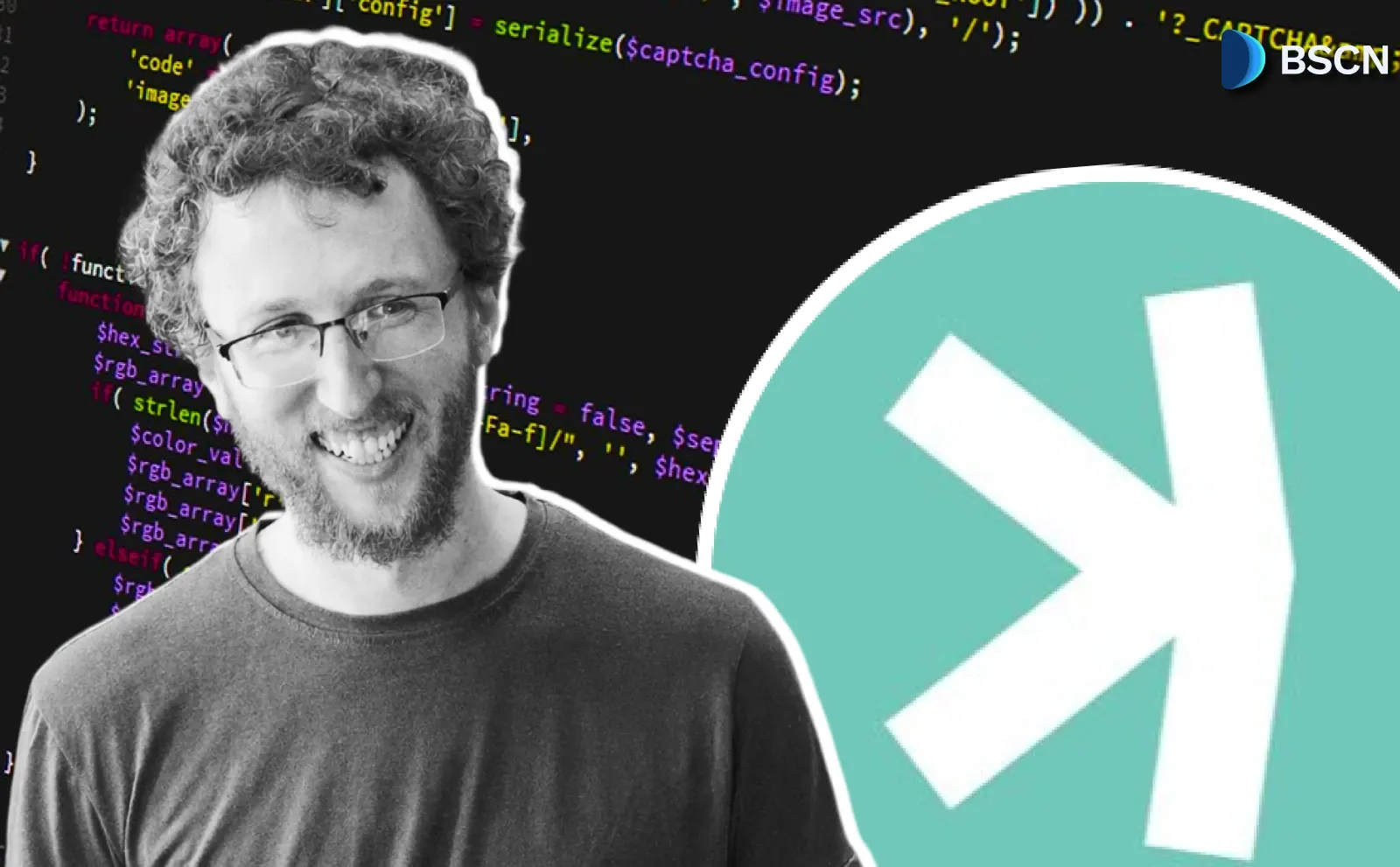
Silverscript is a high-level smart contract language and compiler built for the Kaspa blockchain. Announced on February 10, 2026, by developer Ori Newman, it introduces programmable features directly on Kaspa’s Layer 1 (L1) without relying on external virtual machines or shared global state models such as Ethereum’s EVM.
Silverscript compiles into native Kaspa Script and is designed for Kaspa’s UTXO-based architecture. It enables developers to write readable covenant logic that enforces transaction rules at the protocol level.
What Problem Does Silverscript Solve on Kaspa?
Kaspa is a Proof-of-Work (PoW) cryptocurrency built on a BlockDAG (Directed Acyclic Graph) structure. Unlike linear blockchains, Kaspa processes blocks in parallel. The network currently targets 10 blocks per second, with upgrades such as DAGKnight aiming for 100+ blocks per second.
Until now, Kaspa scripting has been limited in expressiveness. Silverscript addresses this by introducing structured programming features that allow more advanced covenant design while remaining aligned with the UTXO model.
Instead of a shared global state, common in account-based systems, Silverscript maintains a local state per UTXO. This reduces risks such as reentrancy vulnerabilities found in EVM-based systems.
How Does Silverscript Work?
Silverscript is inspired by CashScript, a smart contract language used in Bitcoin Cash. However, it expands on CashScript by adding structured programming tools required for more complex DeFi primitives.
It compiles high-level code into low-level Kaspa opcodes, including:
- KIP-10 (introspection opcodes)
- KIP-16 (zero-knowledge verification opcodes)
- KIP-17 (byte primitives)
It is designed to integrate with upcoming network upgrades scheduled for May 5, 2026, which introduce:
- Covenants++ (advanced spending constraints)
- Native assets under KIP-20 (token lineage and provenance tracking)
- Zero-knowledge (ZK) verification support
Silverscript acts as a development layer for these protocol features.
What Features Does Silverscript Add to Kaspa?
Silverscript introduces structured programming elements that were previously unavailable in Kaspa Script.
Loops
Supports iterative operations such as for loops.
This allows repeated calculations, batch processing, and conditional asset logic.
Arrays
Supports dynamic data structures.
Developers can manage token balances, multi-signature conditions, or structured outputs.
Function Calls
Allows reusable functions with parameters and return values.
Improves code clarity and reduces implementation errors.
Require Statements
Provides built-in assertions.
Contracts can enforce constraints such as array size limits or value checks at compile time or runtime.
UTXO-Focused Design
Operates on local UTXO state rather than shared global state.
This model enforces explicit validation and avoids reentrancy issues.
What Does Silverscript Code Look Like?
Silverscript uses a simplified C-like syntax. The following example demonstrates arrays, loops, and require statements:
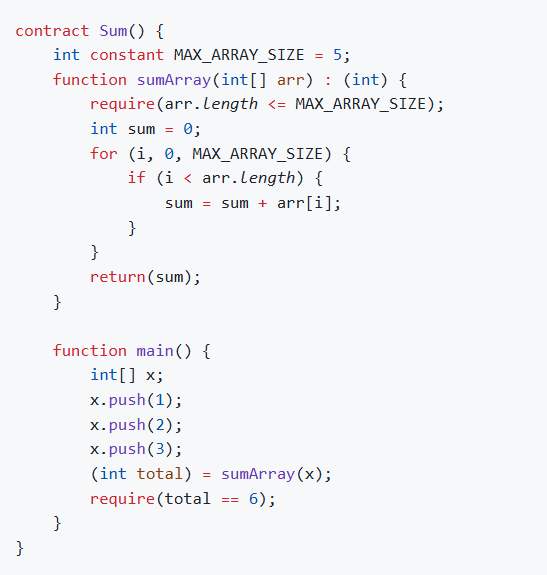
This example defines a function that sums the elements of an integer array. It checks the array length, iterates over the elements, and ensures the sum equals 6.
In production use, similar logic could apply to:
- Token distribution enforcement
- Vault withdrawal conditions
- Escrow validation rules
- Structured DeFi outputs
The syntax is experimental and currently available only on Testnet-12.
How Is Silverscript Different From CashScript?
Silverscript builds on CashScript but extends its capabilities.
Similarities:
- High-level syntax for UTXO-based covenants
- Focus on transaction constraints rather than full Turing completeness
Differences:
- Native support for loops
- Native arrays
- Function definitions and modular structure
- Designed specifically for Kaspa’s BlockDAG
CashScript does not provide built-in support for structured loops or dynamic arrays. Silverscript introduces these features to support more expressive covenant logic.
How Does Silverscript Fit Into Kaspa’s Ecosystem?
Silverscript operates within a broader architecture that separates local and shared state models:
- Local state: Managed by Silverscript via UTXO covenants
- Shared computation: Managed by vProgs (Verifiable Programs), verified on-chain using zero-knowledge proofs
It integrates with:
- KIP-20 native asset support (token provenance enforcement)
- CDAG (Computational DAG) for program dependencies
- Sparkle, a ZK-based rollup framework
This structure enables:
- Automated market makers (AMMs) using enforced output structures
- Lending vaults
- Atomic swaps
- DAO governance encoded in scripts
All without mutable global state.
What Is the Current Development Status?
Silverscript is experimental and compatible only with Kaspa Testnet-12. It is not yet available on the mainnet.
The GitHub repository includes:
- Compiler implementation
- Examples
- TUTORIAL.md documentation
Developer Ori Newman, active in Bitcoin since 2013, maintains the project and has indicated potential support for WebAssembly (WASM) in the future.
Mainnet compatibility depends on the May 5, 2026, hardfork that activates Covenants++ and native asset functionality.
Conclusion
Silverscript introduces structured smart contract development to Kaspa’s UTXO-based BlockDAG network. It adds loops, arrays, functions, and enforceable assertions while compiling to native opcodes. The language aligns with upcoming protocol upgrades, including Covenants++, native assets, and zero-knowledge verification.
Currently limited to Testnet-12, Silverscript provides the technical foundation for programmable Layer 1 applications on Kaspa without adopting shared global state models.
Sources:
- Kaspa GitHub Repository: Silverscript Language tutorial
- X Post: Public announcement by Ori Newman
Read Next...



Frequently Asked Questions
Is Silverscript live on the Kaspa mainnet?
No. It is currently experimental and available only on Testnet-12. Mainnet support depends on the May 5, 2026, hardfork.
Does Silverscript use an EVM or shared global state?
No. It compiles directly to Kaspa Script and operates on a UTXO-based local state rather than a shared global state.
Can Silverscript support DeFi applications?
Yes. It enables covenants for vaults, token management, AMMs, and lending primitives directly on Kaspa’s Layer 1.
Disclaimer
Disclaimer: The views expressed in this article do not necessarily represent the views of BSCN. The information provided in this article is for educational and entertainment purposes only and should not be construed as investment advice, or advice of any kind. BSCN assumes no responsibility for any investment decisions made based on the information provided in this article. If you believe that the article should be amended, please reach out to the BSCN team by emailing [email protected].
Author
 UC Hope
UC holds a bachelor’s degree in Physics and has been a crypto researcher since 2020. UC was a professional writer before entering the cryptocurrency industry, but was drawn to blockchain technology by its high potential. UC has written for the likes of Cryptopolitan, as well as BSCN. He has a wide area of expertise, covering centralized and decentralized finance, as well as altcoins.
(Advertisement)
Latest News
1h : 51m ago

XRP, SOL, and LINK See ETF Inflows While Bitcoin and Ethereum Bleed Millions
5h : 1m ago
World's Best University Buys $87M Ether but Cuts Bitcoin Holdings
6h : 46m ago
What Is Silverscript? Kaspa’s First High-Level Smart Contract Language and Compiler
8h : 29m ago

These Altcoins Are Currently Waiting for ETF Approval
9h : 0m ago

Polygon Flips Ethereum in Daily Fees for the First Time in History
9h : 11m ago

The Dollar Is at Its Most Shorted Level Since 2012. Why Isn't Bitcoin Rallying?
13h : 56m ago
How Low Can XRP Go?
16h : 41m ago

Kraken to Fund Trump Accounts for Every Wyoming Baby Born in 2026
(Advertisement)

Crypto Project & Token Reviews
Project & Token Reviews
Comprehensive reviews of crypto's most interesting projects and assets
Learn about the hottest projects & tokens

Latest Crypto News
Get up to date with the latest crypto news stories and events