Research
(Advertisement)


World's Best University Buys $87M Ether but Cuts Bitcoin Holdings
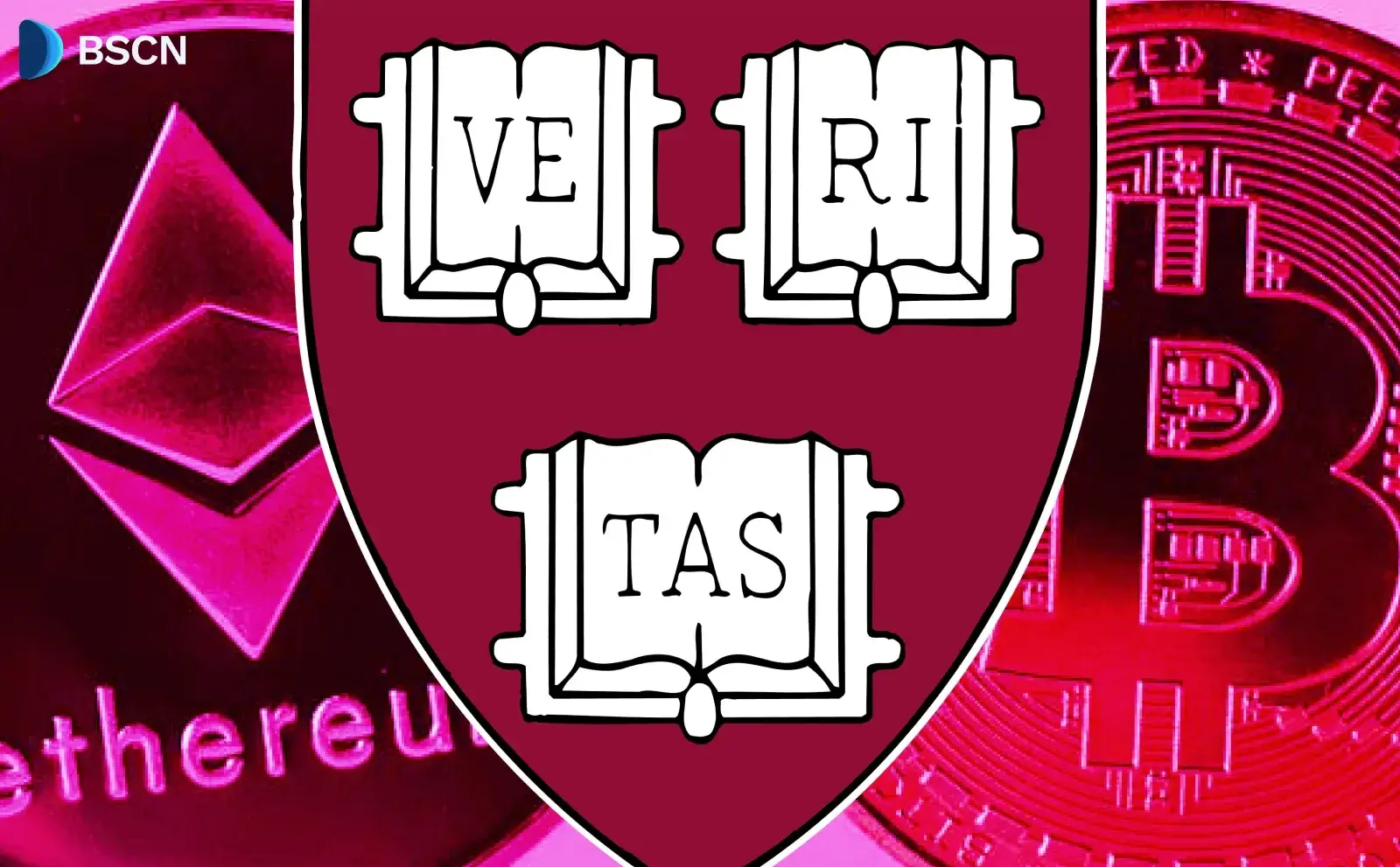
Harvard's $56.9B endowment bought $86.8M in Ethereum ETFs and cut Bitcoin holdings by 21% in Q4 2025. Here's what the filing reveals.

Crypto Rich
February 17, 2026

(Advertisement)
Table of Contents
Harvard University just made its first publicly disclosed bet on Ethereum, and it's not a small one. The university's $56.9 billion endowment dropped $86.8 million into BlackRock's iShares Ethereum Trust (ETHA) during Q4 2025, while trimming its Bitcoin ETF position by 21%. The move, revealed in a 13F filing with the SEC on Friday, puts Harvard's combined crypto exposure at roughly $352.6 million. That's about 0.62% of the total endowment, but it's enough to turn heads across both traditional finance and crypto.
Now, about that "world's best" claim. Harvard holds the number one spot in several current rankings, including U.S. News & World Report and CWUR. But Times Higher Education and QS currently place it around fifth, alongside peers like MIT and Stanford. Unanimously number one? Not quite. Consistently top five worldwide with the largest academic endowment on the planet? Absolutely. And when that kind of institution starts diversifying into ETH, the signal to the broader market is hard to ignore.
What Did Harvard Actually Buy and Sell?
According to the filing, Harvard Management Company (HMC) acquired 3.87 million shares of ETHA. That's the university's first known position in any Ether-linked fund.
On the Bitcoin side, HMC cut 1.48 million shares of BlackRock's iShares Bitcoin Trust (IBIT), bringing its stake down from 6.81 million shares (valued at $442.8 million in Q3) to 5.35 million shares worth $265.8 million at year-end. Even after the trim, Bitcoin remains Harvard's single largest publicly disclosed U.S. equity holding, bigger than its positions in Alphabet, Microsoft, and Amazon.
The timing is worth noting. Bitcoin peaked near $126,000 in October 2025 before sliding to $88,429 by December 31. Ether fell about 28% over the same quarter. Harvard bought into ETH weakness, not strength. As of mid-February 2026, Bitcoin trades near $68,600 and Ether around $1,970, underscoring continued volatility since the filing date.
Why Is Harvard Moving Toward Ether?
The short answer: diversification. HMC isn't dumping Bitcoin. It's spreading its crypto risk across more than one asset.
Harvard's Bitcoin position grew aggressively through 2025. It started with about $117 million in IBIT shares in Q2, then tripled to $442 million by Q3. The Q4 trim looks less like a loss of confidence and more like standard portfolio rebalancing after a concentrated buildup.
Adding Ether gives the endowment exposure to a fundamentally different part of the crypto ecosystem. Bitcoin plays the store-of-value role. Ether underpins smart contracts, DeFi, layer-2 scaling, and a growing staking economy. BlackRock filed an S-1 for a staked Ethereum ETF with the SEC in December 2025, which could eventually let institutional holders like Harvard earn staking yields on their ETH positions.
Endowments think in 20- to 30-year windows. A $56.9 billion fund doesn't rotate into a new asset class on a whim. This looks like a deliberate step toward treating crypto as a multi-asset allocation rather than a single-asset bet.
What Are the Critics Saying?
Not everyone at Harvard's academic level is convinced.
Andrew F. Siegel, an emeritus finance professor at the University of Washington, told The Harvard Crimson that Bitcoin remains "risky" and pointed to a roughly 23% year-to-date loss. Avanidhar Subrahmanyam, a finance professor at UCLA, went further, saying the Ether addition reinforced his concerns about the endowment's crypto strategy. He described crypto as an unproven asset class with unclear valuation frameworks.
On the other side, industry voices see the move as a maturity signal. Jennifer Ouarrag, Head of Legal at staking provider Twinstake, told Decrypt that the shift likely reflects a more differentiated view of opportunity across digital assets. Nima Beni, founder of Bitlease, noted that Bitcoin and Ether serve different structural roles and both belong in institutional portfolios.
The debate is real. But the money is already deployed.
Is Harvard Alone Among Universities?
No. Several major endowments have disclosed crypto positions in recent filings.
Emory University more than doubled its stake in Grayscale Bitcoin Mini Trust to nearly $52 million as of September 2025. Brown University held $13.8 million in IBIT as of Q3 2025, up over 100% from Q1. The University of Austin partnered with Unchained to build a Bitcoin-focused endowment targeting $5 million in long-term BTC holdings. Yale and Dartmouth have historically invested in crypto-focused venture capital funds. MIT, Stanford, Cornell, and the University of Michigan have various levels of indirect or direct exposure through VCs and ETFs.
Research firm MPI estimates that digital assets contributed 200 to 300 basis points to top university endowment returns in recent years. The University of Michigan posted a 15.5% annual return, with roughly 2.9 percentage points attributed to digital assets.
Harvard's move matters most because of its size and reputation. When the biggest endowment in higher education treats crypto as a two-asset allocation instead of a Bitcoin-only trade, it gives cover to every other institutional allocator considering the same step.
What Does This Mean for the Crypto Market?
Harvard isn't going to move ETH's price by itself. But the signaling effect is real. A $56.9 billion endowment choosing to buy Ether during a 28% drawdown, through a regulated BlackRock ETF, sends a message about institutional confidence in ETH's long-term role.
Both positions run exclusively through BlackRock products. That matters. It shows institutions are comfortable with the regulatory framework around spot crypto ETFs and see them as viable vehicles for serious capital deployment.
The combined Ivy League endowments exceed $190 billion, with Harvard's $56.9 billion making up nearly a third of that total. If even a small fraction follows Harvard's lead on ETH diversification, the inflows could be significant. Whether you agree with the academics who call it speculative or the allocators who call it maturity, one thing is clear: the smart money is no longer Bitcoin-only.
Sources:
- The Block — Original reporting on Harvard's Q4 2025 13F filing detailing IBIT and ETHA positions
- The Harvard Crimson — Harvard's student newspaper coverage including academic critic quotes from Siegel and Subrahmanyam
- Decrypt — Industry expert commentary from Twinstake and Bitlease on institutional crypto allocation
- Crypto Valley Journal — Broader context on university endowment crypto holdings and MPI research estimates
- AMBCrypto — Analysis of Q3-to-Q4 rotation dynamics and ETF flow data
Read Next...




Disclaimer
Disclaimer: The views expressed in this article do not necessarily represent the views of BSCN. The information provided in this article is for educational and entertainment purposes only and should not be construed as investment advice, or advice of any kind. BSCN assumes no responsibility for any investment decisions made based on the information provided in this article. If you believe that the article should be amended, please reach out to the BSCN team by emailing [email protected].
Author
 Crypto Rich
Rich has been researching cryptocurrency and blockchain technology for eight years and has served as a senior analyst at BSCN since its founding in 2020. He focuses on fundamental analysis of early-stage crypto projects and tokens and has published in-depth research reports on over 200 emerging protocols. Rich also writes about broader technology and scientific trends and maintains active involvement in the crypto community through X/Twitter Spaces, and leading industry events.
(Advertisement)
Latest News
1h : 52m ago

XRP, SOL, and LINK See ETF Inflows While Bitcoin and Ethereum Bleed Millions
5h : 2m ago
World's Best University Buys $87M Ether but Cuts Bitcoin Holdings
6h : 47m ago

What Is Silverscript? Kaspa’s First High-Level Smart Contract Language and Compiler
8h : 30m ago
These Altcoins Are Currently Waiting for ETF Approval
9h : 1m ago

Polygon Flips Ethereum in Daily Fees for the First Time in History
9h : 12m ago

The Dollar Is at Its Most Shorted Level Since 2012. Why Isn't Bitcoin Rallying?
13h : 57m ago
How Low Can XRP Go?
16h : 42m ago

Kraken to Fund Trump Accounts for Every Wyoming Baby Born in 2026
(Advertisement)

Crypto Project & Token Reviews
Project & Token Reviews
Comprehensive reviews of crypto's most interesting projects and assets
Learn about the hottest projects & tokens

Latest Crypto News
Get up to date with the latest crypto news stories and events