Research
(Advertisement)


Is Bitcoin Mining No Longer Profitable? Analysis

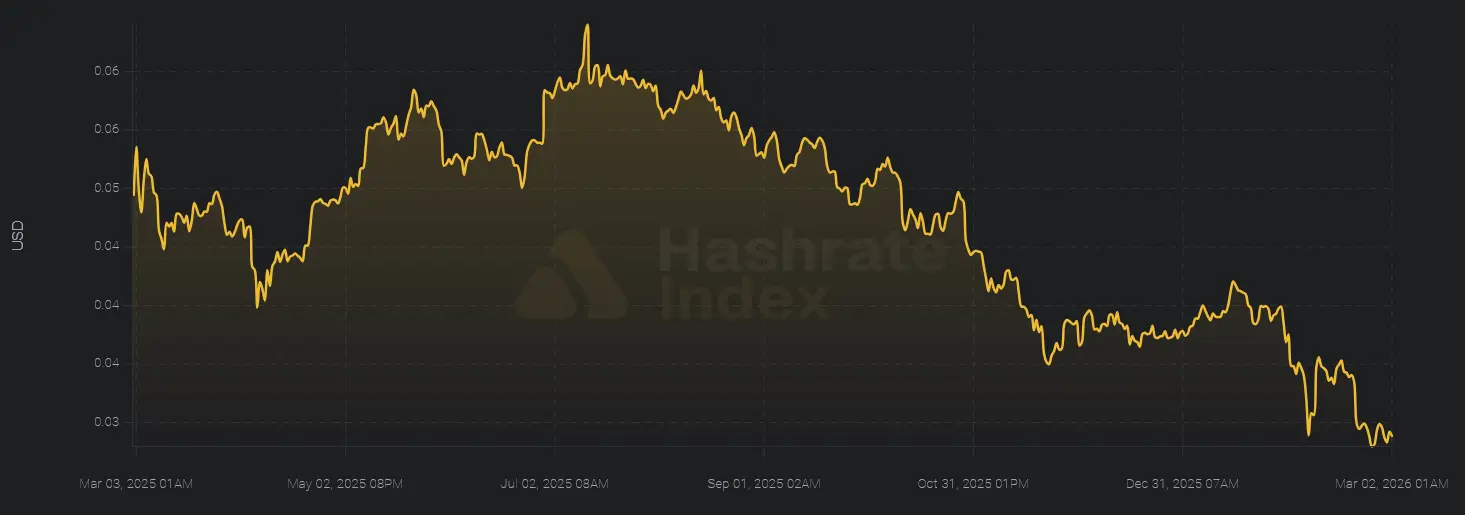
Bitcoin mining revenue has dropped below $0.03 per terahash. With hash price down 30% and difficulty at 144.4T, miners are pivoting to AI to survive.

Crypto Rich
March 2, 2026

(Advertisement)
Table of Contents
For most operators, the honest answer is no. Bitcoin mining has become unprofitable for all but the leanest, cheapest-power operations on the planet. And instead of waiting around for a price recovery, the biggest names in mining are doing something nobody expected five years ago. They are becoming AI companies.
Rosenblatt Securities senior analyst Chris Brendler put it bluntly in a recent client note: with mining revenue now under $0.03 per terahash, the economics are broken for everyone except the most efficient operators. Hash price, the key metric that tracks daily revenue per unit of mining power, has dropped roughly 30% in three months to around $28 per PH/s/day. CryptoQuant's mining profitability indicator hit 21, a 14-month low, while daily mining revenue across the network fell to a yearly low of $28 million.
The numbers have gone from bad to worse. And the industry is responding by transforming into something else entirely.
What Happened to Mining Profitability?
Three forces are crushing miners at the same time.
First, the Bitcoin price. $BTC is down roughly 27% year to date in 2026, trading around $66,000 after peaking above $126,000 in October 2025. Every dollar drop in Bitcoin's price directly reduces the value of block rewards miners earn.
Second, difficulty. On February 18, 2026, Bitcoin's mining difficulty spiked 15% to 144.4 trillion, the largest single increase since the 2021 China ban. That adjustment followed a sharp dip caused by Winter Storm Fern, which knocked out mining operations across 34 U.S. states and temporarily crashed the global hashrate from 1.1 ZH/s to 826 EH/s. Once miners came back online, the difficulty snapped right back up.
Third, the halving hangover. The April 2024 halving cut block rewards from 6.25 BTC to 3.125 BTC. Miners are earning half the Bitcoin they used to, priced at a steep discount from the highs. The math just does not work for most of them anymore.
Why Are Miners Pivoting to AI?
When your core business is bleeding, you look at what assets you actually have. For large-scale Bitcoin miners, the answer is the same thing AI companies are desperately hunting: power infrastructure.
Mining facilities need massive amounts of cheap, reliable electricity and cooling systems. Those are exactly the same requirements for AI data centers. The overlap is almost perfect, and the economics of leasing power to AI tenants are far more attractive than hoping Bitcoin's price recovers.
Brendler summed up the sentiment at Rosenblatt: all miners should now be actively transitioning from BTC to HPC if at all possible. The demand from hyperscalers is insatiable, and deal economics keep improving.
The moves are already happening at the highest levels.
Bitfarms Drops Bitcoin From Its Identity
Bitfarms announced in early February 2026 that it will rebrand as Keel Infrastructure and redomicile from Canada to Delaware. CEO Ben Gagnon did not mince words, declaring the company is no longer a Bitcoin company. Instead, it will focus on building HPC and AI data center infrastructure across North America, leveraging its 2.1 GW energy portfolio.
Shareholders vote on March 20. If approved, the company will trade under the ticker KEEL. It is selling its last Latin American mining operation in Paraguay and has begun repaying its $300 million Macquarie credit facility. The pivot is total.
Starboard Pressures Riot Platforms
Starboard Value, Riot Platforms' fourth-largest shareholder, sent a public letter in February urging the company to accelerate its shift into AI data centers. Starboard pointed to Riot's 1.7 GW of power capacity across its Texas campuses in Corsicana and Rockdale, arguing the sites could generate over $1.6 billion in annual EBITDA (Earnings Before Interest, Taxes, Depreciation, and Amortization) if leased to AI and HPC tenants.
Riot already signed a 10-year, $311 million lease deal with AMD at its Rockdale facility in January. But Starboard called it a small proof of concept and pushed for larger hyperscaler-sized commitments. The investor warned that moving too slowly could leave Riot vulnerable to a takeover.
Who Is Actually Profiting From Mining Right Now?
While U.S. miners bleed cash and pivot strategies, the United Arab Emirates tells a very different story.
According to onchain data from Arkham Intelligence, wallets linked to the UAE Royal Group hold roughly 6,827 BTC valued at approximately $450 million. The estimated unrealized profit sits at $344 million, excluding energy costs. The operation traces back to 2022, when Citadel Mining, tied to the Abu Dhabi royal family, built large-scale facilities on Al Reem Island.
The UAE mines about 3.7 BTC per day and, crucially, holds almost everything it produces. The last notable outflow from these wallets happened about four months ago. While Western miners are forced to sell into weakness just to cover electricity bills, the UAE is doing the opposite: steadily accumulating through the drawdown, effectively converting cheap energy into a strategic digital reserve.
This geographic power shift is significant. The UAE benefits from low energy costs, state-backed capital, and zero pressure to sell. American miners, burdened by rising costs, post-halving economics, and shareholder demands, are pivoting to AI just to survive.
What Comes Next?
Bitcoin mining is not dead. The network's hashrate has already recovered to around 1 ZH/s, and well-capitalized operations with access to electricity at $0.06 per kWh or lower can still run profitably. But for the broader industry, the pure-play mining model is fading fast.
At least eight publicly traded mining companies are now partially or fully shifting toward AI data centers, including Core Scientific, IREN, Cipher Mining, TeraWulf, and CleanSpark. Some, like Bitfarms, plan to exit Bitcoin mining entirely by 2027. Others expect AI to become their primary revenue source within two years.
Bitcoin mining is not going anywhere. But the biggest players are no longer betting everything on it. The industry is splitting in two: lean, efficient miners who stick to what they know, and large publicly traded operators diversifying into AI infrastructure where the margins are better and the revenue is predictable. Mining gets less concentrated. AI gets more power. And the companies that adapt fastest will be the ones still standing when the next halving hits.
Sources:
- CNBC Rosenblatt analyst Chris Brendler's note on hash price falling below $0.03/TH and mining profitability collapse across the sector.
- Bitfarms Investor Relations Official press release on Bitfarms rebranding to Keel Infrastructure and redomiciling from Canada to Delaware.
- Starboard Value Full public letter to Riot Platforms CEO and Executive Chairman urging accelerated AI data center pivot.
- Bloomberg Reporting on Starboard Value pressing Riot Platforms to transition from Bitcoin mining to AI infrastructure.
- Arkham Intelligence Original onchain research identifying UAE Royal Group mining wallets, Citadel Mining operations, and sovereign BTC holdings.
- The Block Mining difficulty 15% jump to 144.4T, hashrate rebound data following Winter Storm Fern.
Read Next...



February 27, 2026
Disclaimer
Disclaimer: The views expressed in this article do not necessarily represent the views of BSCN. The information provided in this article is for educational and entertainment purposes only and should not be construed as investment advice, or advice of any kind. BSCN assumes no responsibility for any investment decisions made based on the information provided in this article. If you believe that the article should be amended, please reach out to the BSCN team by emailing [email protected].
Author
 Crypto Rich
Rich has been researching cryptocurrency and blockchain technology for eight years and has served as a senior analyst at BSCN since its founding in 2020. He focuses on fundamental analysis of early-stage crypto projects and tokens and has published in-depth research reports on over 200 emerging protocols. Rich also writes about broader technology and scientific trends and maintains active involvement in the crypto community through X/Twitter Spaces, and leading industry events.
(Advertisement)
Latest News
1h : 8m ago

How Much is Crypto Legend Arthur Hayes Actually Worth?
2h : 35m ago

Are Crypto Investors Turning to Gold as Altcoins Struggle?
3h : 27m ago
Chainlink ETFs See Constant Inflows Since December Launch
6h : 16m ago

BubbleMaps Says Possible Insiders Made ~$1 Million Betting on Iran Strikes
6h : 48m ago

Is Bitcoin Mining No Longer Profitable? Analysis
11h : 11m ago

XRP Could Do to Options What Hyperliquid Did to Futures, Here Is How
12h : 24m ago

The Last Step Before Tokenized Communities Launch: $ION Set to List on Exchanges
13h : 56m ago

Bitcoin Is Flashing the Same Signal It Did Before Its Last 300% Rally
(Advertisement)

Crypto Project & Token Reviews
Project & Token Reviews
Comprehensive reviews of crypto's most interesting projects and assets
Learn about the hottest projects & tokens

Latest Crypto News
Get up to date with the latest crypto news stories and events