News
(Advertisement)


CLARITY Act Got Its Biggest Break Yet — Is Crypto Law Finally Happening?
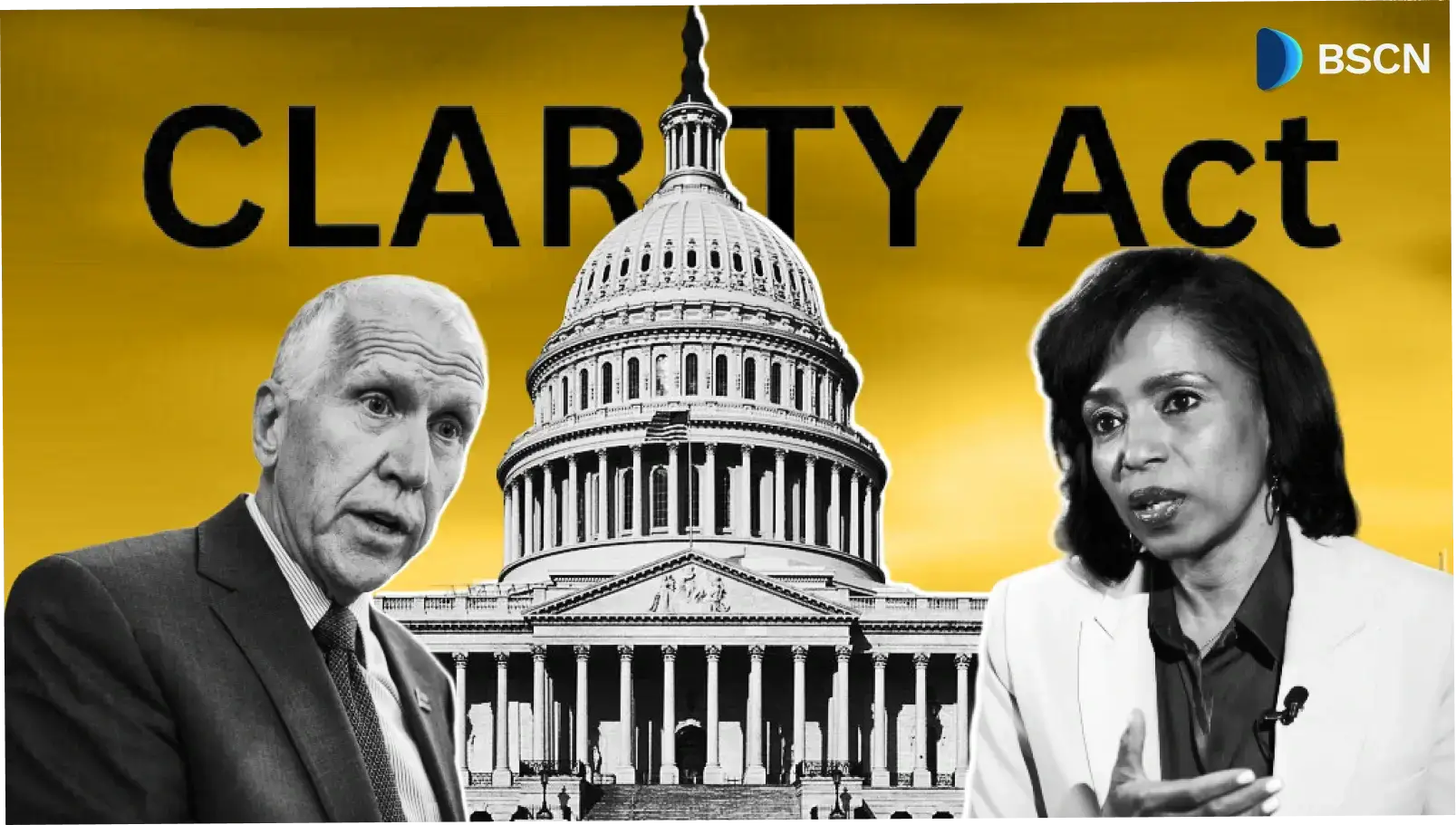
Senators Tillis and Alsobrooks reach an agreement in principle with the White House on stablecoin yield, potentially unblocking the stalled CLARITY Act. Here's what changed.

Soumen Datta
March 23, 2026

(Advertisement)
Table of Contents
The stall may finally be breaking. Senators Thom Tillis (R-N.C.) and Angela Alsobrooks (D-Md.) have reached an agreement in principle with White House officials on stablecoin yield language, the central dispute that has kept the Digital Asset Market CLARITY Act frozen in the Senate Banking Committee since January 2026, according to Politico. If the compromise holds, it clears the most significant technical obstacle the bill has faced since passing the House in July 2025 with a 294-134 bipartisan vote.
What Is the CLARITY Act and Why Does It Matter?
The CLARITY Act is a proposed federal law that would establish permanent rules governing how crypto exchanges, brokers, dealers, and custodians operate in the United States. Crucially, it would grant the Commodity Futures Trading Commission (CFTC) a formal spot-market authority over digital commodities, a category that covers most blockchain-native tokens whose value is tied to network use.
SEC Chair Paul Atkins said on March 17 that no Commission action can future-proof the crypto rulebook the way legislation can. His point was that: agency guidance is a temporary bridge, and the statute is the permanent destination. Without the CLARITY Act, enforcement and interpretation remain tools that change with each administration.
The bill covers market structure, not just stablecoins. It would set legal definitions for when a digital asset is a commodity versus a security, regulate custodial arrangements, and establish exchange registration requirements. For institutions that have been holding back on crypto allocation due to legal uncertainty, that framework is a sizing decision, not just a policy preference.
What Was the Stablecoin Yield Dispute Actually About?
The sticking point was whether crypto platforms should be allowed to pay yield on stablecoin balances held by users. Stablecoins like USDC and USDT are pegged to the U.S. dollar and typically backed by short-term U.S. Treasuries. Platforms wanted to pass some of that yield back to users, typically in the range of 2 to 5 percent annually.
Banks pushed back hard. The American Bankers Association argued that paying yield on stablecoin balances amounted to unlicensed deposit-taking. Standard Chartered estimated that if stablecoins were allowed to offer returns competitive with savings accounts, they could pull roughly $500 billion from U.S. bank deposits by the end of 2028. That gave opponents a concrete systemic-risk argument, and the bill stalled through February and into March.
The reported compromise, according to Senator Alsobrooks, would bar yield payments on passive balances. The precise language has not been made public, and both senators have said they still need to vet the terms with industry stakeholders before it can be treated as final.
Where the Negotiations Stand Right Now
The picture coming out of the DC Blockchain Summit this last week is more detailed than a single headline suggests:
- Senator Lummis confirmed a late April markup date for the Senate Banking Committee
- Her press team reported stablecoin yield negotiations are 99% of the way to resolution
- DeFi-related language in the bill has largely been addressed
- White House crypto adviser Patrick Witt credited Tillis and Alsobrooks for bridging the partisan divide
- Senate Banking Republicans are now discussing attaching community bank deregulatory provisions to the bill as part of a broader legislative trade involving housing policy
That last point is significant. The CLARITY Act started as a digital asset market structure bill. It is now being used as part of a wider political negotiation that includes housing and community bank regulation. Whether that speeds things up or complicates them further depends on how those side deals land.
Senator Bernie Moreno warned last week that if the bill does not advance by May, digital asset legislation may not receive serious consideration again for years. The Senate Banking Committee markup is the first of five sequential steps the bill must complete before reaching the President's desk.
How Are Institutional Investors Responding to the CLARITY Act's Progress?
Wall Street has been pricing CLARITY Act probability for months, and the data is concrete. In January 2026, VanEck noted that Bitcoin's relative strength partly reflected optimism around the bill. In the same period, Bitcoin ETP flows swung from $1.3 billion in outflows to $440 million in inflows, with $1.66 billion flowing in between January 12 and 14 alone.
Citi cut its 12-month Bitcoin price target in March from $143,000 to $112,000, citing stalled U.S. legislation as a factor narrowing the window for regulatory catalysts. Its bull case sits at $165,000, and its bear case at $58,000. The spread between those numbers reflects, in part, whether legislation passes.
JPMorgan told clients in February that crypto markets could receive a meaningful lift in the second half of 2026 if market structure legislation passes by midyear, because it would end regulation-by-enforcement and open the door to broader institutional participation.
What the Institutional Survey Data Shows
A March 2026 survey of 351 institutional investors by Coinbase and EY-Parthenon put direct numbers on the demand waiting behind regulatory clarity:
- 65% of firms planning to increase crypto holdings cited improved regulatory clarity as a key driver
- 66% said regulatory uncertainty was their primary concern
- 78% identified market structure as the area most in need of clear guardrails
- The share of firms allocating more than 5% of assets under management to digital assets is projected to climb from 18% to 29% by year-end
Those figures describe a pool of institutional capital that is conditionally ready to move. The condition is largely legislative.
What Still Has to Happen Before CLARITY Becomes Law?
Even with the stablecoin yield compromise in place, the path is not short. The Senate Banking Committee markup, now targeted for late April, is step one of five sequential stages before the bill reaches the President's desk. After that:
- The Senate Banking and Senate Agriculture Committee drafts must be reconciled with each other
- The combined Senate version must then be reconciled with the House-passed version
- The bill needs at least seven Senate Democratic votes to clear procedural hurdles
- Unresolved disputes remain around elected officials profiting from crypto ventures and anti-money-laundering requirements
- Senate floor time is increasingly scarce as midterm campaign season approaches
Reconciliation between two committee drafts and then between the Senate and House versions can take months on its own.
Conclusion
The stablecoin yield dispute is 99% resolved by Senator Lummis's own account, the White House is publicly backing the compromise, and the Senate Banking Committee has a late April markup target. By the standards of where this bill stood in January, that is a meaningful shift.
But five sequential steps, a crowded Senate calendar, unresolved ethics disputes, and a new political wrinkle involving community bank deregulation still stand between an agreement in principle and a signed law.
For investors, the mechanism is structural rather than immediate. CLARITY Act passage does not move Bitcoin the next morning. It reduces the legal friction keeping institutional capital on the sidelines, which supports ETF inflows, deeper markets, and greater custodial confidence over time.
Senator Moreno's May deadline is the number to watch.
Resources
Report by Politico: Senators, White House strike ‘agreement in principle’ to resolve bank-crypto clash
Report by Reuters: US banks may lose $500 billion to stablecoins by 2028, Standard Chartered warns
Report by The Hill: Trump regulators forge ahead with crypto rules amid Senate holdups
Report by CoinDesk: Key U.S. senator on crypto market structure bill negotiation: 'We think we've got it'
Research by Coinbase and EY-Parthenon: 2026 Institutional Investor Digital Assets Surve
Report by CoinDesk: Crypto markets – and the American people – deserve clarity
Press release by US SEC: SEC Clarifies the Application of Federal Securities Laws to Crypto Assets
Congressional bill text: Digital Asset Market Clarity Act of 2025 (H.R. 3633)
Senate Banking Committee discussion draft: Responsible Financial Innovation Act of 2025
Read Next...



Frequently Asked Questions
What is the CLARITY Act's stablecoin yield compromise?
Senators Tillis and Alsobrooks reached an agreement in principle with the White House to bar yield payments on passive stablecoin balances. This was the central dispute between banks, who feared deposit flight, and crypto firms, who wanted to pass returns from Treasury-backed reserves to users. Full details have not been published, and industry vetting is still ongoing.
How does the CLARITY Act affect Bitcoin's price?
The mechanism is structural rather than immediate. Passage of the CLARITY Act would reduce legal uncertainty for exchanges, custodians, and ETF operators, which supports institutional participation and ETF inflows over time. Citi directly cited stalled legislation as a reason for cutting its Bitcoin price target in March 2026. JPMorgan flagged it as a potential second-half 2026 catalyst.
What happens if the CLARITY Act does not pass by May 2026?
Senator Moreno warned that a failure to advance by May could push meaningful digital asset legislation off the table for years. The Senate floor calendar becomes increasingly dominated by midterm election dynamics after that point, leaving the crypto industry reliant on SEC and CFTC interpretive guidance rather than a statutory framework.
Disclaimer
Disclaimer: The views expressed in this article do not necessarily represent the views of BSCN. The information provided in this article is for educational and entertainment purposes only and should not be construed as investment advice, or advice of any kind. BSCN assumes no responsibility for any investment decisions made based on the information provided in this article. If you believe that the article should be amended, please reach out to the BSCN team by emailing [email protected].
Author
 Soumen Datta
Soumen has been a crypto researcher since 2020 and holds a master’s in Physics. His writing and research has been published by publications such as CryptoSlate and DailyCoin, as well as BSCN. His areas of focus include Bitcoin, DeFi, and high-potential altcoins like Ethereum, Solana, XRP, and Chainlink. He combines analytical depth with journalistic clarity to deliver insights for both newcomers and seasoned crypto readers.
(Advertisement)
Latest News
4h : 31m ago
CLARITY Act Got Its Biggest Break Yet — Is Crypto Law Finally Happening?
7h : 1m ago

Google Chrome Got a Critical Security Patch, But Your Crypto Wallet Might Still Be at Risk
10h : 16m ago

Is Missouri About to Make XRP an Official State Reserve Asset?
March 20, 2026

Can ASTER Dominate The Perps Sector?
March 20, 2026

Elon Musk is Tweeting About DOGE Again: What's Next?
March 20, 2026

Animoca Brands Invests in Ava Labs to Expand Avalanche in Asia and Middle East
March 20, 2026

Zebec Takes Streaming Payroll to Stellar in First Move Outside Solana
March 20, 2026

SEC Chair Says Crypto Markets and the American People Deserve Clarity
(Advertisement)

Crypto Project & Token Reviews
Project & Token Reviews
Comprehensive reviews of crypto's most interesting projects and assets
Learn about the hottest projects & tokens

Latest Crypto News
Get up to date with the latest crypto news stories and events