Deepdive
(Advertisement)


What Is Mind Network and Why Does FHE Matter?

Mind Network uses Fully Homomorphic Encryption to keep AI agent data encrypted during computation. Here's what FHE means for Web3 privacy.

Crypto Rich
February 19, 2026

(Advertisement)
Table of Contents
Mind Network is a blockchain project built around Fully Homomorphic Encryption (FHE), a type of cryptography that lets systems run computations on encrypted data without ever decrypting it. That means data stays private not just when it's stored or sent, but while it's being used. Calling itself the confidential payment infrastructure for the AI agent economy, Mind Network has processed over 245 million encrypted transactions and raised $13.25 million in funding, building a real footprint in the FHE space since launching in 2023.
But what does that actually look like in practice, and why should you care?
Why Is Encryption During Computation Such a Big Deal?
Most encryption today protects data in two states: at rest (sitting on a server) and in transit (moving between systems). The problem is the third state. When data needs to be processed, it typically gets decrypted first, creating a window where it's exposed. That's the vulnerability FHE eliminates.
Think of it like sending a locked box to a factory. The factory can build something inside the box, rearrange what's in it, and send it back, all without ever opening the lock. That's what FHE enables for digital data. You can run calculations, verify transactions, or train AI models on information that never leaves its encrypted state.
This matters a lot for AI agents. As autonomous systems start handling payments, accessing APIs, and making decisions on behalf of users, the data they work with needs stronger protection than traditional encryption offers. FHE could be the missing layer that makes trustless AI-agent interactions live up to the name.
Who Built Mind Network?
The project emerged in late 2022 to early 2023 from a team with roots in AI, security, and cryptography. CEO Mason Song leads a group that includes PhDs and professors from Cambridge University, along with alumni from Google, Microsoft, and IBM. Core team members were among 12 global Ethereum Foundation Fellows focused on cryptography and security, a relationship that later led to two EF research grants for the project's FHE work.
Early on, the team tackled Vitalik Buterin's "Stealth Address Open Problem" with MindSAP, a solution combining FHE with stealth addresses. That work put Mind Network on the map in Ethereum's cryptography circles.
Total funding sits at $13.25 million: a $2.5 million seed round in 2023, a $10 million pre-Series A in 2024, and a $750,000 public IDO in April 2025. Key backers include YZI Labs, HashKey Capital, Animoca Brands, MH Ventures, Cogitent Ventures, and ArkStream Capital.
What Has Mind Network Actually Shipped?
x402z is a confidential agent-to-agent payment solution built on the HTTP 402 "Payment Required" concept, upgraded for Web3 using FHE. Currently on testnet since January 2026, it's designed to let AI agents pay for compute, data, and API access with encrypted settlements using the ERC-7984 standard co-developed with Zama. Validators can verify transaction validity without ever seeing the actual amounts or sender balances.
MindChain is the first FHE chain built specifically for AI agents, according to the team.
AgenticWorld provides FHE consensus for AI agent swarms, incorporating HTTPZ, a zero-trust protocol the team co-developed with Zama. HTTPZ extends the concept of HTTPS by keeping data encrypted during storage, transfer, and computation, essentially adding encryption to the processing layer that HTTPS misses.
Mind Bridge and FHE Bridge handle secure cross-chain value transfers, including an FHE-powered encrypted transfer layer for USDC cross-chain movements.
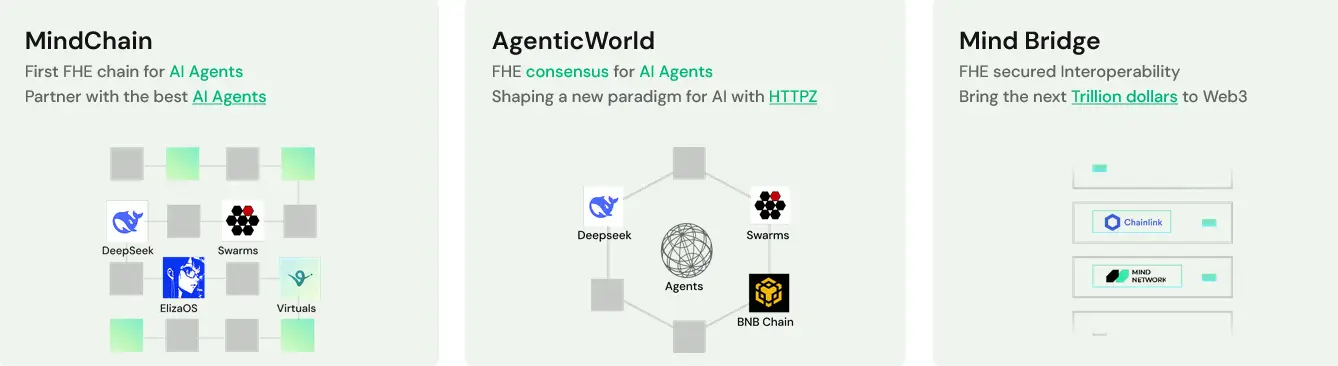
By February 2026, the network reports 7,964 FHE-protected agents, over 2.1 million "CitizenZ" users (a digital sovereignty framework using Soulbound NFTs), and more than 20 FHE Hubs integrated with partners. The project ranks first in both FHE and AI categories on RootData.
Recent partnerships announced in February 2026 include PayAI Network for encrypted agent payment settlements, AdEx Network for privacy in agent execution, and ENI for scalable AI confidential computing. The team also deployed an FHE-based MCP service on BytePlus.
How Does FHE Compare to Other Privacy Tech?
FHE sits in a different category than Zero-Knowledge Proofs (ZK), Multi-Party Computation (MPC), or Trusted Execution Environments (TEE), though Mind Network integrates with all of them.
ZK proofs let you verify a statement is true without revealing the underlying data. That's useful for authentication and verification, but it doesn't let you compute on encrypted data. MPC splits data across multiple parties, so no single party sees the full picture, but it requires coordination. TEEs create secure hardware enclaves, but they depend on trusting the hardware manufacturer.
FHE is the only approach that allows arbitrary computation on fully encrypted data with no trust assumptions about the processing environment. It's also quantum-resistant and was approved by NIST as a post-quantum encryption standard in 2024, which gives it a longer shelf life as quantum computing advances.
The tradeoff is computational overhead. FHE operations are significantly more resource-intensive than plaintext operations, which has historically limited practical adoption. Mind Network's bet is that hardware improvements and optimized implementations (like their FHE-Rust SDK and open-source FCN codebase) will close that gap.
What About the $FHE Token?
$FHE launched on April 10, 2025, through a Token Generation Event on PancakeSwap via Binance Wallet. The initial IDO raised $750,000 at $0.015 per token.
The token runs on BNB Chain with a total supply of 1 billion FHE. Circulating supply sits at roughly 351 million as of early 2026. It's used for network fees, node incentives, staking, and security. Over 39 million $FHE is currently staked.
Tokenomics lean heavily toward community distribution, with 41.7% of the total supply allocated to airdrops and rewards. The next vesting unlock is scheduled for March 2026, releasing 5 million FHE.
As of February 19, 2026, $FHE trades at approximately $0.040 with a market cap of around $14 million, ranked #801 on CoinMarketCap.
What Are the Risks?
FHE's biggest technical challenge remains computational intensity. Running operations on encrypted data requires significantly more processing power than working with plaintext, and while that gap is narrowing, it's still a real constraint for high-throughput applications.
Market risk is the other obvious factor. A $14 million market cap means relatively low liquidity, and the token's price history from a $0.015 IDO to $0.040 shows the kind of volatility typical for smaller-cap projects.
The backing from investors like YZI Labs and Animoca Brands, along with two Ethereum Foundation research grants, provides some confidence in the team's technical direction, but adoption of FHE as a Web3 standard is still in its early stages. HTTPZ and the broader vision of a "fully encrypted internet" are ambitious targets that depend on ecosystem-wide buy-in.
Where Does Mind Network Go From Here?
The roadmap focuses on scaling AgenticWorld and MindChain, expanding FHE Hub integrations, and driving adoption of the HTTPZ protocol. Ongoing CitizenZ rewards suggest future airdrops for active participants.
If FHE delivers on its promise as a practical privacy infrastructure for AI agents, Mind Network is well-positioned as an early mover. The question is whether the technology can scale fast enough to match the speed at which the AI agent economy is growing.
For more information, visit mindnetwork.xyz or follow @mindnetwork_xyz on X.
Sources:
- Mind Network Official Site — Project overview, product descriptions, and current network statistics
- Mind Network Documentation — Technical details on FHE, HTTPZ protocol, and encryption architecture
- Mind Network Medium Blog — Founding team background, Ethereum Foundation fellowship, and MindSAP development
- CryptoRank — Funding round details, investor breakdown, and tokenomics data
- CoinMarketCap — Current $FHE price and market cap ranking
- Phemex — Token supply data and tokenomics breakdown
- Gate.io — Vesting schedule and upcoming token unlock information
- @mindnetwork_xyz on X — partnership announcements and x402z testnet launch
Read Next...



Frequently Asked Questions
What is Fully Homomorphic Encryption (FHE)?
FHE is a form of encryption that allows computations to be performed directly on encrypted data without decrypting it first. This means sensitive information stays protected even while being actively processed, unlike traditional encryption which only secures data at rest or in transit.
What blockchain does the $FHE token run on?
$FHE operates on BNB Chain. It launched on April 10, 2025, via PancakeSwap through Binance Wallet with a total supply of 1 billion tokens and roughly 351 million in circulation as of early 2026.
How is Mind Network different from Zero-Knowledge Proof projects?
While ZK proofs verify that a statement is true without revealing underlying data, they don't enable computation on encrypted information. FHE allows arbitrary calculations on fully encrypted data with no trust assumptions, making it suited for AI agent operations where data needs to remain private throughout processing.
Disclaimer
Disclaimer: The views expressed in this article do not necessarily represent the views of BSCN. The information provided in this article is for educational and entertainment purposes only and should not be construed as investment advice, or advice of any kind. BSCN assumes no responsibility for any investment decisions made based on the information provided in this article. If you believe that the article should be amended, please reach out to the BSCN team by emailing [email protected].
Author
 Crypto Rich
Rich has been researching cryptocurrency and blockchain technology for eight years and has served as a senior analyst at BSCN since its founding in 2020. He focuses on fundamental analysis of early-stage crypto projects and tokens and has published in-depth research reports on over 200 emerging protocols. Rich also writes about broader technology and scientific trends and maintains active involvement in the crypto community through X/Twitter Spaces, and leading industry events.
(Advertisement)
Latest News
0h : 14m ago

Mystery Firm Holds $436M in BlackRock Bitcoin ETF - and Nothing Else
1h : 38m ago

Ledger Joins Canton Network as Super Validator
3h : 15m ago

Perle Labs Hits 1 Million Annotators and 1 Billion Points
3h : 43m ago

What Really Happened Inside Trump's Invite-Only Crypto Summit at Mar-a-Lago
4h : 29m ago

Janction Partners With Cabinet to Scale Web3 in Japan
6h : 56m ago

What Is Mind Network and Why Does FHE Matter?
7h : 3m ago

Banks and Crypto Clash Over the CLARITY Act: What Is at Stake?
7h : 43m ago
Soil Brings Real-World Asset Yields to XRPL, Giving RLUSD Holders a New Way to Earn
(Advertisement)

Crypto Project & Token Reviews
Project & Token Reviews
Comprehensive reviews of crypto's most interesting projects and assets
Learn about the hottest projects & tokens

Latest Crypto News
Get up to date with the latest crypto news stories and events