Deepdive
(Advertisement)


What is the Ethereum Validator Queue & Why Does it Matter?

Ethereum's validator queue controls how stakers enter and exit the network. A massive entry-exit imbalance may signal bullish sentiment for ETH.

Crypto Rich
March 3, 2026

(Advertisement)
Table of Contents
The Ethereum validator queue is a built-in traffic system that controls how many stakers can join or leave the network at any given time. Think of it like a velvet rope at both the entrance and the exit. Right now, the line to get in dwarfs the line to get out by a factor of roughly 181 to 1 in ETH terms, and that lopsided ratio is turning heads across the crypto space.
How Does the Validator Queue Actually Work?
Ethereum runs on proof-of-stake. Validators lock up at least 32 ETH to help secure the network, propose blocks, and verify transactions. In return, they earn staking rewards.
To keep the network stable, Ethereum caps how many validators can activate or exit during each epoch, a 6.4-minute window made up of 32 slots at 12 seconds each. This cap is called the churn limit.
The churn limit currently sits at 256 ETH per epoch, roughly eight validators worth. When demand to enter or exit exceeds that rate, a queue forms. It works first-come, first-served.
There are two queues:
- Entry (activation) queue: New validators waiting to go live after depositing their ETH. The queue grows when staking demand outpaces the churn rate.
- Exit queue: Validators waiting to leave and withdraw their staked ETH. After clearing this queue, there is an additional sweep delay of roughly 8.3 days before funds actually hit a wallet.
These queues are features, not bugs. They prevent sudden mass entries or exits that could destabilize consensus or compromise finality.
What Do the Current Numbers Look Like?
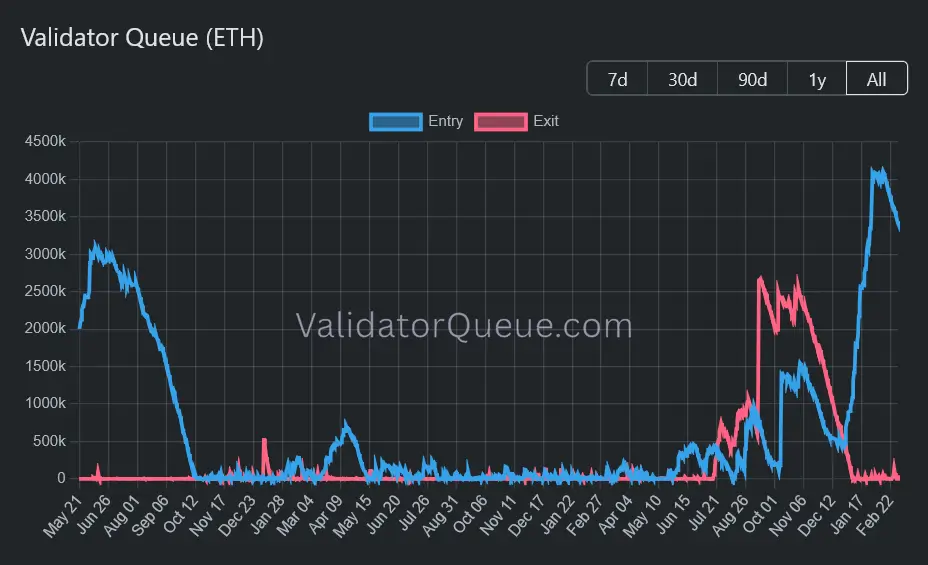
As of March 3, 2026, the imbalance is striking. Data from ValidatorQueue.com paints a clear picture.
The entry queue holds roughly 3,385,238 ETH, representing about 105,788 validators waiting to activate. The estimated wait time to get in sits at 58 days and 19 hours. On the other side, the exit queue holds just 18,656 ETH with a wait time of 7 hours and 46 minutes.
In some recent snapshots, the ratio has been even more extreme. Just days ago, entry ETH sat at roughly 3.47 million while exits were as low as 96 ETH, a ratio of roughly 36,000 to 1 that made the rounds across crypto media.
Across the broader network, about 37.2 million ETH is staked, roughly 30.61% of total supply. There are 955,911 active validators running. The current staking APR hovers around 2.85%.
Why Is This Imbalance Considered Bullish?
The validator queue has become something of a sentiment gauge for the Ethereum ecosystem. When entry demand massively outweighs exits, it tells you a few things.
Supply Pressure
Every ETH that enters the staking queue is ETH pulled off the open market. At current prices near $1,950, the entry queue alone represents around $6.6 billion in buying pressure being locked up. That reduces the circulating supply, which, in theory, supports price over time.
Confidence Signal
A near-empty exit queue means validators are not rushing to cash out. Despite modest yields of under 3%, stakers are choosing to stay locked in. Post-Pectra automatic compounding of rewards gives them even less reason to exit, since yields now reinvest without manual intervention. That signals long-term conviction rather than short-term speculation.
Institutional Weight
Much of the recent inflow has been institutional. BitMine, the largest Ethereum treasury firm, has staked over 1.8 million ETH. Grayscale has staked roughly 74% of its ETH holdings and became the first U.S. spot Ethereum ETF to distribute staking rewards to investors in January 2026. The Pectra upgrade in May 2025 made large-scale staking easier by raising the maximum validator stake from 32 ETH to 2,048 ETH and enabling automatic compounding of rewards.
Historical Pattern
This kind of queue flip has happened before. In late 2025, exits briefly dominated, with the exit queue hitting a record 46 days in September after a major infrastructure provider pulled out 1.6 million ETH. That reversed sharply by early 2026, and the current one-sided entry demand mirrors patterns that have historically preceded price rallies.
Are There Any Risks to Watch?
The bullish read is not guaranteed to play out. ETH tested $2,140 on February 25 and got rejected, and it remains range-bound near $1,950 to $2,000. Staking demand alone does not automatically translate into price action. Whale accumulation has been modest, with large holders adding only about 60,000 ETH in the past week.
There is also the question of whether extended wait times could discourage new stakers. A nearly two-month queue is a long time to wait, especially if market conditions shift. And if a major staking provider decides to exit again, as it did last September, the exit queue can spike fast.
If inflows continue and churn does not increase significantly, wait times could stretch even further, reinforcing the supply lock-up narrative but testing patience for newcomers.
Still, the overall pattern is clear. More capital is flowing into Ethereum staking than out of it, and by a wide margin. Whether you read it as a bullish signal or simply a sign of a maturing network, the validator queue has earned its place as one of the most useful on-chain indicators in the Ethereum ecosystem.
Sources:
- ValidatorQueue.com - Real-time Ethereum validator entry and exit queue data
- Liquid Collective - Detailed explanation of Ethereum's activation and exit queue mechanics
- CoinDesk - Coverage of Ethereum's record 46-day exit queue in September 2025
- Cryptopolitan - Reporting on the entry queue record high and institutional staking activity
- The Coin Republic - Analysis of the entry-exit imbalance and ETH price dynamics
- Everstake - Breakdown of the October 2025 entry queue surge and institutional drivers




Disclaimer
Disclaimer: The views expressed in this article do not necessarily represent the views of BSCN. The information provided in this article is for educational and entertainment purposes only and should not be construed as investment advice, or advice of any kind. BSCN assumes no responsibility for any investment decisions made based on the information provided in this article. If you believe that the article should be amended, please reach out to the BSCN team by emailing [email protected].
Author
 Crypto Rich
Rich has been researching cryptocurrency and blockchain technology for eight years and has served as a senior analyst at BSCN since its founding in 2020. He focuses on fundamental analysis of early-stage crypto projects and tokens and has published in-depth research reports on over 200 emerging protocols. Rich also writes about broader technology and scientific trends and maintains active involvement in the crypto community through X/Twitter Spaces, and leading industry events.
(Advertisement)
Latest News
2h : 15m ago

Major Bitcoin Miner to Dump its $BTC to Fund AI Plans
4h : 41m ago

What is the Ethereum Validator Queue & Why Does it Matter?
5h : 10m ago

Why Do Investors Choose BlackRock's Bitcoin ETF?
6h : 35m ago
Meet Vera Report, The App That Lets You Whistleblow Anonymously From a Smartphone Using Telegram Messenger
6h : 51m ago
Ripple $XRP in 2026: The Year so Far
9h : 36m ago

Fed Rate Cuts & Money Printing Incoming, Says Hayes
13h : 5m ago

Pump.fun Stopped Being Just a Memecoin App, Here’s Why
17h : 5m ago

Near Launches Confidential Intents to Stop MEV Bots in Their Tracks
(Advertisement)

Crypto Project & Token Reviews
Project & Token Reviews
Comprehensive reviews of crypto's most interesting projects and assets
Learn about the hottest projects & tokens

Latest Crypto News
Get up to date with the latest crypto news stories and events