News
(Advertisement)


Pi Network’s App Studio Expands Creator Access, Unveils New Event and Payment Integration in Early 2026

Pi App Studio updates in 2026 add creator incentives, Test Pi payments, and ad supported deployment to expand app creation.

UC Hope
January 22, 2026

(Advertisement)
Table of Contents
After unveiling its developer library to boost development, Pi Network has released its first general update in 2026, kicking off the year with a new creator-wide event and features to enhance participation in its ecosystem. According to the protocol’s blog post on January 21, the App Studio has introduced a set of updates that expand how apps are created, tested, and monetized inside the Pi ecosystem.
The updates focus on three areas. First, a creator event to collect structured user feedback. Second, a simplified way to integrate Pi payments into apps without requiring technical development. Third, an ad-supported option that allows creators to deploy apps even when they do not want to spend Pi.
Together, these changes reflect Pi Network's continued effort to increase app utility and reduce barriers to participation. The updates target both non-technical users and experienced builders, encouraging experimentation while managing infrastructure costs and mitigating platform abuse.
What is the Pi App Studio?
Pi App Studio is a tool in the Pi Browser that lets Pioneers create and deploy functional apps through guided workflows and AI-assisted prompts. The platform is designed for people without coding experience. Each app iteration and deployment uses Pi credits, reflecting underlying costs such as server resources and API usage.
The latest updates aim to make the creation process more accessible while still discouraging spam and low-effort deployments.
Pi App Studio Creator Event Explained
The App Studio creator event invites Pioneers to complete a short survey focused on two areas. First, feedback on existing App Studio features and workflows. Second, identification of apps that users consider genuinely useful within the ecosystem.
Participation is initiated by tapping the banner at the top of the App Studio interface. Responses are reviewed for quality, and spam submissions are excluded.
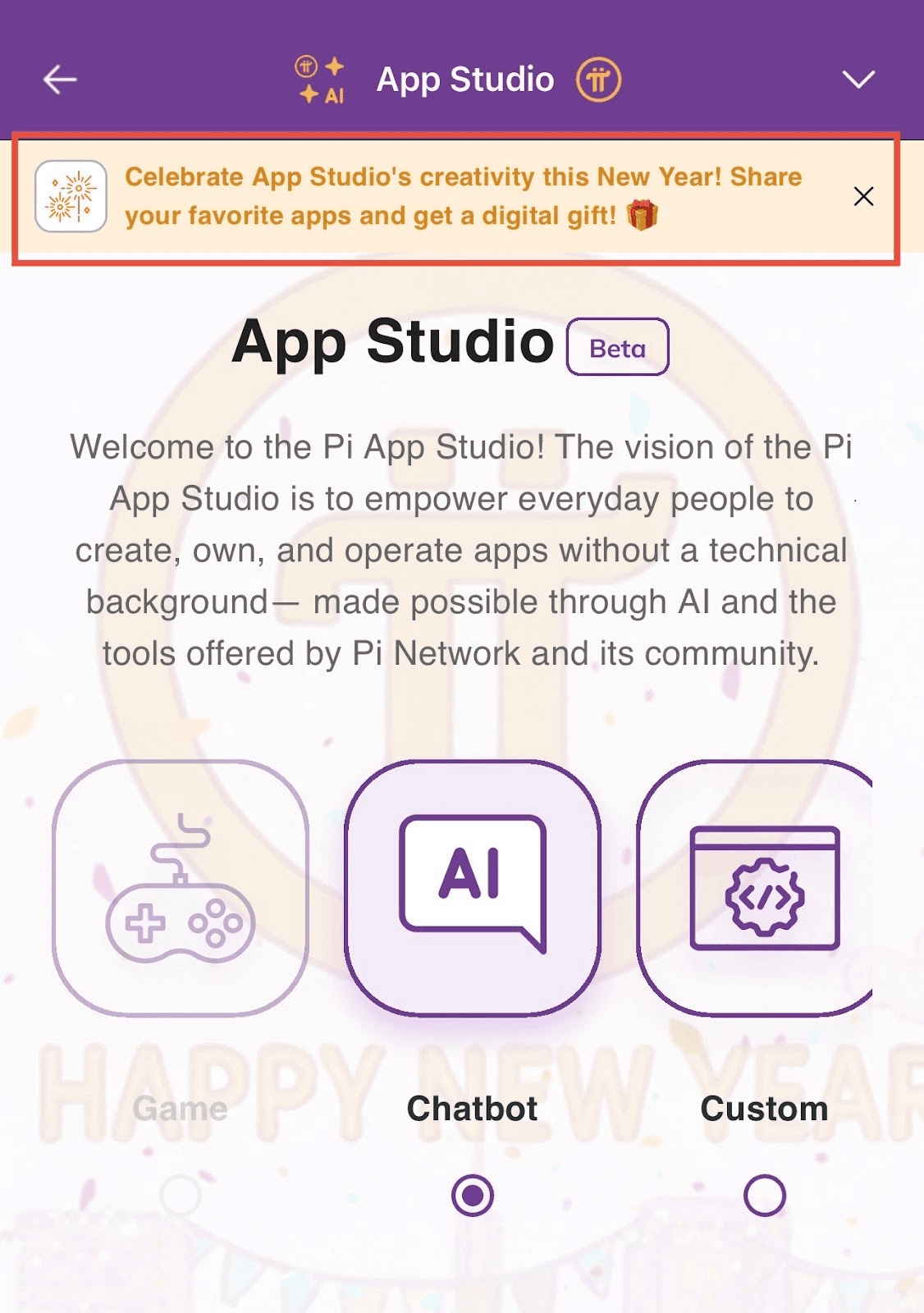
The first 1,000 qualified respondents receive 5 Pi credits. These credits are restricted to use inside App Studio and can only be applied to app creation and customization.
Purpose of the Pi Credits
Each AI-generated app iteration and server deployment incurs a Pi cost. For new creators, this cost can limit experimentation. The 5 Pi credit incentive is intended to reduce that friction. It allows users to test ideas, refine prompts, and iterate on app behavior without immediately spending their own Pi balance.
The incentive also encourages users who have not previously created apps to try the process themselves. Since App Studio is built for non-technical users, the event lowers both financial and psychological barriers to entry.
How Feedback Will Be Used
Pi Network has stated that survey responses will directly impact future improvements to the App Studio. This includes adjustments to workflows, feature prioritization, and usability changes.
From an ecosystem perspective, this feedback loop is significant. It provides structured input from active users rather than relying solely on passive metrics.
Easy Pi Payment Integration for Apps
Pi App Studio now supports in-app Pi payment integration through a guided, easy process. Payments currently operate using Test Pi, not Mainnet Pi.
Traditionally, integrating Pi payments required developer knowledge and time. Even with the introduction of a developer library that reduces integration time to roughly ten minutes, payment setup still assumes familiarity with development tools.
App Studio abstracts this complexity. Creators can add payment functionality by following interactive steps during app customization. No coding is required.
How Creators Enable Payments
To use the payment feature, a creator must first create a new custom app in App Studio within the Pi Browser.
Once the app is created, the creator selects the Customize App With Pi AI option and includes the phrase Pi payment in the prompt. The system then generates payment interactions within the app logic.
A video walkthrough is available within the interface to guide users through the process. BSCN will also release a short guide explaining how users can use the feature in the application.
Scope and Limitations of the Initial Release
The current implementation supports only session-based payments. A session refers to a single, self-contained instance of activity within an app. Examples include a game round, a task sequence, or a specific experience.
Users can purchase items or unlock features during that session. However, purchases are not persistent. If a user exits the app and returns later, previous purchases are not retained.
While limited, this approach establishes a foundation for future payment functionality. It also allows creators to experiment with monetization mechanics ahead of Mainnet-enabled payments.
Implications for Creator Monetization
By simplifying payment integration, App Studio lowers the threshold for creators to explore revenue models. This is particularly relevant for non-technical users who previously could not realistically implement payment logic.
The feature supports the creation of sustainable app use cases without requiring external development teams. Over time, this could lead to a wider range of functional apps that generate economic activity within the Pi ecosystem.
Ad-Supported App Deployment
A second major update allows creators to deploy app iterations without paying Pi by watching ads. This option becomes available when a user’s App Studio balance falls below 0.25 Pi.
The feature is designed primarily for users who are not yet Mainnet-migrated or who prefer not to spend Pi during early experimentation. By watching ads, they can continue creating and deploying apps.
Pi Network has explicitly stated that ad revenue does not cover the actual cost of app generation and deployment. These costs include server infrastructure and external service usage.
The ad option functions as a subsidy rather than a profit mechanism. Its purpose is to expand access while still imposing a time cost on creators. This helps deter automated spam and abuse without excluding users based on migration status or Pi balance.
“Note that ad revenue generated by this feature does not cover (not even on the same magnitude) the cost of app-generation and deployment in the App Studio, including API costs and server costs. This approach is intentionally designed to subsidize app creation costs in App Studio to broaden access and increase creation participation, while preventing spamming and exploitation of the platform,” the blog reads.
Because the subsidy does not fully offset costs, the feature is subject to change or cancellation. Its continuation depends on economic sustainability and platform health.
This transparency is notable. Rather than presenting the feature as permanent, Pi Network frames it as an experimental measure that will be adjusted based on real usage data.
Conclusion
The early 2026 updates to Pi App Studio expand access to app creation while maintaining clear operational boundaries. The creator event introduces a structured feedback loop and targeted incentives that reduce experimentation costs. Simplified Pi payment integration allows non-technical users to add transactional functionality, even with current session-based limits. The ad-supported deployment option broadens participation without obscuring the real costs of infrastructure.
Overall, these changes reinforce App Studio’s role as a practical utility builder within Pi Network. Rather than emphasizing scale alone, the updates focus on usability, controlled experimentation, and incremental integration of economic activity. This measured approach supports the sustainable growth of apps that serve real functions inside the Pi ecosystem.
Sources:
- Pi Network Blog: App Studio Utilities, Payment Integration, and Creator Event
- Pi Browser Mobile: App Studio Interface Update
Read Next...





Frequently Asked Questions
What is Pi App Studio used for?
Pi App Studio allows users to create, customize, and deploy apps within the Pi ecosystem without coding. It uses guided workflows and AI-assisted prompts to support non-technical creators.
Are Pi payments in App Studio using Mainnet Pi?
No. The current payment integration uses Test Pi only. Persistent and Mainnet-enabled payments are not yet supported.
Can non-migrated users create apps in App Studio?
Yes. With the ad-supported deployment option, users who are not Mainnet-migrated can deploy app iterations by watching ads instead of paying Pi.
Disclaimer
Disclaimer: The views expressed in this article do not necessarily represent the views of BSCN. The information provided in this article is for educational and entertainment purposes only and should not be construed as investment advice, or advice of any kind. BSCN assumes no responsibility for any investment decisions made based on the information provided in this article. If you believe that the article should be amended, please reach out to the BSCN team by emailing [email protected].
Author
 UC Hope
UC holds a bachelor’s degree in Physics and has been a crypto researcher since 2020. UC was a professional writer before entering the cryptocurrency industry, but was drawn to blockchain technology by its high potential. UC has written for the likes of Cryptopolitan, as well as BSCN. He has a wide area of expertise, covering centralized and decentralized finance, as well as altcoins.
(Advertisement)
Latest News
2h : 1m ago

BlackRock Dominates Crypto ETFs
3h : 12m ago

Aptos Activity Surges as Network Costs Plummet
3h : 43m ago

How Low Can Bitcoin Go as Oil Hits $100?
4h : 28m ago

Here's What Michael Saylor Thinks of Altcoins
7h : 13m ago
XRP Holders Could Finally Earn Yield Without Touching Ethereum: Details
10h : 58m ago

Binance and CZ Beat a Terrorism Lawsuit, There Is Just One Catch
March 6, 2026

Bitcoin Miners are Dumping BTC: Sell-Pressure Incoming
March 6, 2026

Coinbase's Special Relationship with President Trump
(Advertisement)

Crypto Project & Token Reviews
Project & Token Reviews
Comprehensive reviews of crypto's most interesting projects and assets
Learn about the hottest projects & tokens

Latest Crypto News
Get up to date with the latest crypto news stories and events